
You leave home with plenty of charge, a familiar route, and a dashboard range estimate that seems comfortably generous. Then the temperature climbs, traffic slows to a crawl, or a winter storm arrives—and the estimate falls faster than expected.
For an electric-vehicle driver, this can feel unsettling because the energy system is less visible than a fuel tank. Yet most weather- and traffic-related range loss has understandable engineering causes, from battery chemistry to cabin heating and repeated acceleration.
The goal is not to chase a perfect dashboard number or drive uncomfortably to save every watt-hour. It is to understand where energy goes, plan with realistic margins, and use the features built into the vehicle intelligently.
Whether you are evaluating your first EV, studying vehicle systems, or managing an electric fleet, the same principle applies: range is a changing operating result, not a fixed property printed on a brochure.
🔋 Range Is an Operating Result, Not a Constant
An EV’s quoted range is measured under a defined test procedure. Real driving adds variables: ambient temperature, road speed, elevation, wind, payload, tyre condition, cabin comfort settings, and traffic flow.
Think of the battery as an energy store and range as the distance obtained after every vehicle system has taken its share. The traction motor uses energy to move the car, while heating, cooling, lighting, pumps, computers, and battery conditioning also draw power.
That is why two drivers in the same model can see different results on the same day. Neither dashboard has necessarily made an error; the vehicles may simply be operating under different conditions.
📏 The Energy-Use Equation Behind Driving Range
At a simple level, usable battery energy divided by energy consumption gives approximate range. Consumption is often displayed as watt-hours per kilometre or mile, while efficiency may be shown as kilometres or miles per kilowatt-hour.
A larger value in Wh/km means more energy is needed to travel each kilometre. If usable energy falls temporarily in cold conditions while consumption rises because of heating and resistance, the distance available between charging stops can shrink from both directions.
Range estimates are therefore predictions based on recent and planned driving conditions. They are useful planning tools, but they should not be treated as a contractual promise for every journey.
🌡️ Why Temperature Affects the Whole Vehicle
Temperature changes more than the battery. It alters battery electrochemistry, air density, tyre rolling resistance, cabin-conditioning demand, and the viscosity of lubricants in components such as reduction gears.
Hot weather generally raises cooling demand. Cold weather often creates a larger combined penalty because the battery may be less efficient and the car may need substantial energy to warm both the cabin and battery pack.
The exact effect varies widely by model, battery design, heat-pump equipment, driving speed, and trip length. Avoid assuming that another owner’s winter experience will precisely match your own.
🥶 Cold Batteries Deliver Energy Less Easily
Lithium-ion cells move ions through an electrolyte during charging and discharging. At low temperature, those processes slow down and internal resistance rises. Internal resistance is the opposition to current flow inside the cell.
Higher resistance means a greater voltage drop when the driver requests power. The battery-management system may limit available power or reserve more energy to protect the cells, so the usable portion of the pack can feel smaller until it warms.
This is not simply “lost” capacity in a permanent sense. After the battery returns to a suitable temperature, much of the temperature-related limitation usually recedes. Repeated exposure to severe conditions, however, still calls for sensible charging and storage practices.
🔥 Hot Weather Creates a Different Battery Challenge
Heat normally allows a battery to deliver power readily, but excessive temperature is undesirable for cell life and safe operation. EVs monitor pack temperature and use liquid or air-based thermal-management systems to keep cells within a preferred range.
Cooling pumps, fans, and a refrigerant compressor consume energy. During a hot motorway trip, the battery may need cooling while the cabin air conditioner is also running, creating two separate but related thermal loads.
A well-designed system protects the pack rather than allowing it to overheat. The practical consequence for the driver may be modest added consumption, slower charging at a hot fast charger, or reduced power if temperatures approach system limits.
❄️ Cabin Heating Can Dominate Short Winter Trips
An internal-combustion vehicle has abundant waste heat from its engine. An EV is efficient precisely because it produces far less waste heat, so it must often create cabin heat deliberately.
Resistance heaters convert electricity directly into heat and can draw considerable power. On a short trip, the energy needed to warm cold air, seats, glass, trim, and occupants may be large relative to the energy used for propulsion.
That is why a ten-minute winter commute can look inefficient even if the route is gentle. Once the cabin and battery are warm, the heating demand often becomes lower and steadier.
♨️ Heat Pumps Reduce Heating Demand—Within Limits
A heat pump moves heat rather than creating all of it through electrical resistance. In favourable conditions, it can provide cabin warmth using less electrical energy than a resistance heater.
Its advantage is not unlimited. As outside air becomes very cold, extracting useful heat becomes harder, and many systems use supplementary resistance heating when needed. Defrosting requirements can also change the energy balance.
For buyers, a heat pump can be a valuable cold-climate feature, particularly for frequent winter driving. For owners, it is helpful but not a reason to ignore winter route planning or preconditioning.
🪑 Warm People Before Warming Every Surface
Heated seats and a heated steering wheel transfer warmth directly to the driver and passengers. They usually need much less energy than raising the temperature of the entire cabin quickly.
On a cold solo commute, a practical strategy is to set a moderate cabin temperature, use seat and wheel heating, and dress appropriately for the conditions. This can preserve comfort without asking the HVAC system to heat every interior surface aggressively.
Safety comes first: windows must remain clear, and occupants must not become cold or distracted. Energy-saving settings should never compromise visibility or alertness.
🔌 Preconditioning Uses the Best Energy Source First
Preconditioning warms or cools the cabin—and on some vehicles the battery—before departure. When performed while connected to a charger, much of that energy can come from the grid rather than the driving battery.
For winter travel, scheduled preheating can start the journey with clearer glass, a more comfortable cabin, and a battery closer to an efficient operating temperature. In summer, precooling reduces the initial air-conditioning surge.
Departure scheduling is especially useful because it lets the car finish preparation near the time it leaves. Exact behaviour differs by manufacturer, so owners should learn whether their vehicle conditions the battery, the cabin, or both.
🧊 Battery Preconditioning Helps Fast Charging
Battery preconditioning is distinct from cabin preconditioning. It brings the pack toward a temperature suitable for rapid DC charging, often when the driver navigates to a compatible charging station using the vehicle’s route planner.
A cold battery may accept charge slowly because the management system limits current to avoid harmful lithium plating. Lithium plating is an unwanted condition in which lithium deposits on an electrode instead of being properly stored within the cell structure.
Using navigation to a fast charger can therefore save total journey time even though the car spends energy warming the pack. The energy cost may be worthwhile because it reduces waiting and supports battery protection.
☀️ Air Conditioning Is Usually Not the Main Highway Load
Air conditioning certainly consumes energy, especially when cooling a sun-soaked cabin. Yet at steady highway speed, aerodynamic drag often requires much more power than the cabin compressor.
This distinction matters because switching off the air conditioner may deliver less benefit than slowing down slightly. In very hot weather, moderate cooling is also a safety and comfort feature, not an indulgence.
Park in shade when practical, use sunshades, and precool while plugged in. These measures lower the initial thermal load without forcing occupants to endure an unsafe or exhausting cabin environment.
🌬️ Highway Speed Magnifies Aerodynamic Drag
Air resistance rises rapidly as speed increases. The power required to overcome aerodynamic drag rises approximately with the cube of speed, which is why a modest speed reduction can make a noticeable difference on a long, fast journey.
Headwinds have a similar effect because the vehicle experiences higher air speed. A calm outbound leg can be followed by a surprisingly energy-intensive return if the wind direction changes.
In hot or cold weather, high speed combines with climate-control demand. The most effective adjustment is often smooth, legal speed moderation rather than extreme changes to comfort settings.
🛞 Cold Tyres Add Rolling Resistance
Rolling resistance is the energy lost as tyres deform where they meet the road. Cold rubber is less flexible, and tyre pressures typically fall as ambient temperature falls, both of which can increase the energy needed to keep the vehicle moving.
Check tyre pressure when tyres are cold, using the manufacturer’s vehicle-specific recommendation. Do not inflate to the maximum number molded on the tyre sidewall; that is not usually the recommended operating pressure.
Winter tyres can also raise consumption compared with low-rolling-resistance summer tyres, though their safety benefit in appropriate snow and ice conditions is far more important than a modest range penalty.
🚦 Heavy Traffic Changes the Energy Pattern
Traffic does not always mean poor EV efficiency. Low average speeds reduce aerodynamic losses, and regenerative braking can recover part of the energy normally lost during deceleration.
However, stop-start driving still requires repeated acceleration, while cabin conditioning, electronics, lights, and thermal systems continue running during every minute of delay. Long queues in intense heat or cold can therefore consume meaningful energy without adding distance.
The key variable is not merely traffic density but the combination of delay, acceleration pattern, weather, and auxiliary load. A warm mild city drive may be efficient; a freezing, congested commute may not be.
↩️ Regenerative Braking Recovers Only Part of Motion
Regenerative braking turns the traction motor into a generator during deceleration. It sends some kinetic energy back to the battery, reducing the energy that would otherwise be lost as heat in friction brakes.
Recovery is limited by conversion losses, battery temperature, battery state of charge, and available grip. A full or very cold battery may accept less regenerative energy, so the vehicle may rely more heavily on conventional braking.
Regeneration rewards anticipation. Looking ahead, lifting off the accelerator early, and avoiding unnecessary acceleration-brake cycles reduce total energy use more effectively than relying on regeneration to repair aggressive driving.
🚗 Smooth Driving Beats Last-Second Braking
In slow traffic, leave a sensible following gap and maintain a steady rolling pace where conditions allow. Each avoided stop prevents the car from having to rebuild its speed from zero.
Use drive modes and regenerative-braking settings that make smooth control easy, but do not let a strong one-pedal setting encourage abrupt deceleration. Passenger comfort, tyre grip, and predictable traffic behaviour remain priorities.
Driver-assistance systems can help maintain speed and spacing, yet they are not substitutes for observation. Weather, lane changes, motorcycles, and unexpected queues still require an attentive driver.
🧭 Plan for Elevation, Wind, and Detours
Route planning should look beyond the shortest distance. Climbing uses substantial energy because the vehicle gains gravitational potential energy; descending can recover only part of it through regeneration.
Mountain routes, strong headwinds, road closures, and winter diversions deserve a larger charge margin than a familiar flat route. Navigation systems that model elevation and charging stops are useful, but predictions can change with weather and driving conditions.
For an unfamiliar trip, identify more than one suitable charger near key stops. This is not pessimism; it is the same sensible contingency planning used for fuel, weather, and rest breaks.
📊 Read the Dashboard Without Becoming a Slave to It
A state-of-charge percentage measures stored energy more directly than a range estimate. The estimated kilometres or miles remaining are valuable, but they are calculated from assumptions and recent consumption.
Many EVs provide an energy screen showing climate use, driving efficiency, and predicted arrival state of charge. These displays are especially helpful when conditions change, because they reveal whether speed, heating, terrain, or traffic is driving consumption.
Watch trends rather than reacting to every one-unit change. If predicted arrival charge declines steadily, act early by reducing speed, selecting a nearer charger, or adjusting the route.
📋 A Practical Weather-and-Traffic Planning Check
Before a demanding trip, take a minute to turn uncertainty into a simple plan. The following checks are more useful than obsessively recalculating the exact possible range.
- Confirm the departure charge and the expected arrival charge, not just the displayed range.
- Check temperature, wind, rain or snow, and likely congestion periods.
- Set the intended charging stop in the built-in navigation system if battery preconditioning depends on it.
- Allow a reserve for detours, queues, charger availability, and reduced efficiency.
- Verify tyre condition and pressure before long journeys.
The right reserve depends on route familiarity and available charging. Remote winter travel needs more margin than an urban route with many reliable alternatives.
⚡ Choose Charging Stops for Reliability, Not Just Distance
A charger that is theoretically optimal on a map may be inconvenient if it is crowded, out of service, difficult to access, or located at the end of a risky low-charge leg. Charging strategy is part of range management.
For long trips, it is often quicker to arrive with a sensible reserve, charge efficiently in the battery’s favourable charging range, and continue, rather than waiting to fill the pack to a very high state of charge at every stop.
Charging curves vary by model. DC fast charging often slows as battery state of charge rises, so route-planning software can be more practical than a fixed rule such as “always charge to full.”
🔢 Compare the Main Range Penalties
| Condition | Primary energy effect | Most useful response |
|---|---|---|
| Cold short trip | Cabin heat, cold battery, cold tyres | Precondition while plugged in; use seat heating; plan a reserve |
| Hot motorway drive | Aerodynamic drag, cabin cooling, battery cooling | Precool, use shade, moderate speed, avoid unnecessary roof loads |
| Stop-start winter traffic | Time-based heating load and repeated acceleration | Drive smoothly, maintain space, monitor arrival charge |
| Cold fast-charging stop | Limited battery charge acceptance | Navigate to the charger early enough for battery preconditioning |
The table is a decision aid, not a prediction model. Actual energy use depends on the vehicle, weather severity, road surface, driving style, and battery condition.
🏠 Daily Charging Supports Better Winter Readiness
Drivers with home or workplace charging can begin many trips with a predictable state of charge and use scheduled cabin preparation while connected. This reduces the stress caused by winter’s less favourable energy balance.
Follow the manufacturer’s recommended daily charge limit. Some vehicles suggest a lower routine limit for battery longevity while allowing a higher setting before a long journey. The correct practice depends on the battery chemistry and vehicle guidance.
Avoid leaving the battery at an extreme state of charge for long periods when it is unnecessary, particularly in high heat. The owner’s manual remains the authority for model-specific care.
🧳 Payload and Roof Accessories Matter More at Speed
Passengers and cargo increase vehicle mass, which raises energy use during acceleration and climbing. The effect is usually less dramatic on flat, steady roads than drivers expect, but it becomes relevant in hilly terrain and stop-start conditions.
Roof boxes, bicycle carriers, and open roof racks can be more consequential because they disrupt airflow. At highway speed, their aerodynamic penalty can persist for every kilometre.
Remove unused accessories before a long trip and pack thoughtfully. This is not about travelling light at all costs; it is about recognising that a vehicle’s shape matters strongly at speed.
🌧️ Rain, Snow, and Road Surface Add Resistance
Wet roads increase tyre resistance because tyres must displace water, while rain may require wipers, lights, demisting, and a more cautious driving pace. Slush and snow can impose much greater rolling resistance.
In such conditions, energy use can rise while average speed falls. The lower aerodynamic drag does not necessarily offset the added tyre resistance, heating demand, and reduced opportunity for steady driving.
Never attempt to recover range by driving faster through adverse weather. Safe speed, visibility, traction, and extra travel time matter far more than arriving with a slightly higher battery percentage.
🛠️ Maintenance Protects Everyday Efficiency
EVs need less routine mechanical service than many conventional vehicles, but efficiency still depends on basic care. Underinflated tyres, poor wheel alignment, dragging brakes, damaged underbody panels, or neglected cabin filters can all affect energy use or thermal performance.
If consumption changes suddenly under similar conditions, investigate rather than assuming the battery has failed. Check tyres first, then consider seasonal changes, roof accessories, software updates, and any warning messages.
Battery-health information should be interpreted carefully. A temporary cold-weather reduction in available energy is different from long-term capacity degradation, which develops gradually and requires proper diagnostic assessment.
⚠️ Common Range-Saving Mistakes to Avoid
Some advice sounds efficient but creates inconvenience, risk, or negligible savings. Good range management is measured decision-making, not a contest in discomfort.
- Do not turn off demisting when glass needs to remain clear.
- Do not rely on a single distant charger with almost no arrival reserve.
- Do not repeatedly fast-charge a cold pack when the vehicle offers preconditioning.
- Do not use maximum tyre sidewall pressure as a range tactic.
- Do not assume regeneration will fully offset hard acceleration or steep climbs.
- Do not interpret a seasonal range change as automatic proof of battery damage.
The safest strategy is normally also the calmest: anticipate conditions, preserve a buffer, and make small early adjustments.
🧑🔧 What Engineers Design Into Modern EVs
Vehicle engineers address range variability through thermal management, battery-management software, efficient heat pumps, aerodynamic design, low-rolling-resistance tyres, predictive navigation, and regenerative-braking calibration.
Battery-management systems estimate cell temperature, voltage, current, and state of charge. They may restrict charging or power output when conditions could harm performance or durability. These limits can frustrate a driver briefly, but they are protective controls rather than arbitrary restrictions.
No design removes physics. Engineering reduces the penalty and gives the driver better tools, while operating conditions still determine the final consumption figure.
🧪 Battery Chemistry and Vehicle Design Create Differences
Not all EVs react identically to temperature. Battery chemistry, pack size, insulation, cell arrangement, active thermal management, heat-pump availability, and software strategy all influence cold- and hot-weather behaviour.
A larger battery may provide more absolute energy reserve, but it can also require more energy and time to warm. A smaller, efficient vehicle may use less energy per kilometre but leave less flexibility if conditions deteriorate.
When comparing vehicles, look beyond a single quoted range. Examine winter-oriented equipment, charging performance, route-planning features, tyre specification, and the type of journeys the vehicle will actually make.
🧠 Build a Personal Consumption Baseline
After a few weeks, most drivers can develop a realistic baseline for familiar routes: mild-weather commute, rainy commute, winter commute, and highway travel. This personal record is often more useful than generic online claims.
Note broad patterns rather than trying to create laboratory data. For example, you may learn that a certain route needs a larger winter reserve, or that a particular charging stop works best after navigation-based preconditioning.
This knowledge reduces range anxiety because decisions become evidence-based. You are no longer reacting to an unfamiliar estimate; you are comparing today’s conditions with a practical history.
🗺️ A Hypothetical Winter Traffic Scenario
Imagine an EV beginning a winter evening journey with a route estimate that appears comfortable in mild weather. The driver expects freezing temperatures, slow city traffic, and a final uphill section before reaching a destination charger.
A sensible plan would be to preheat while plugged in, enter the destination in navigation, use a moderate cabin setting with heated seats, and select a backup charger before leaving. In traffic, the driver maintains a smooth pace instead of alternating hard acceleration and braking.
If the predicted arrival charge begins falling, the driver slows slightly on faster sections or uses the planned backup. The lesson is not that winter travel is unreliable; it is that conditions should be included in the plan from the start.
✅ The Core Principle: Manage Energy, Conditions, and Margin
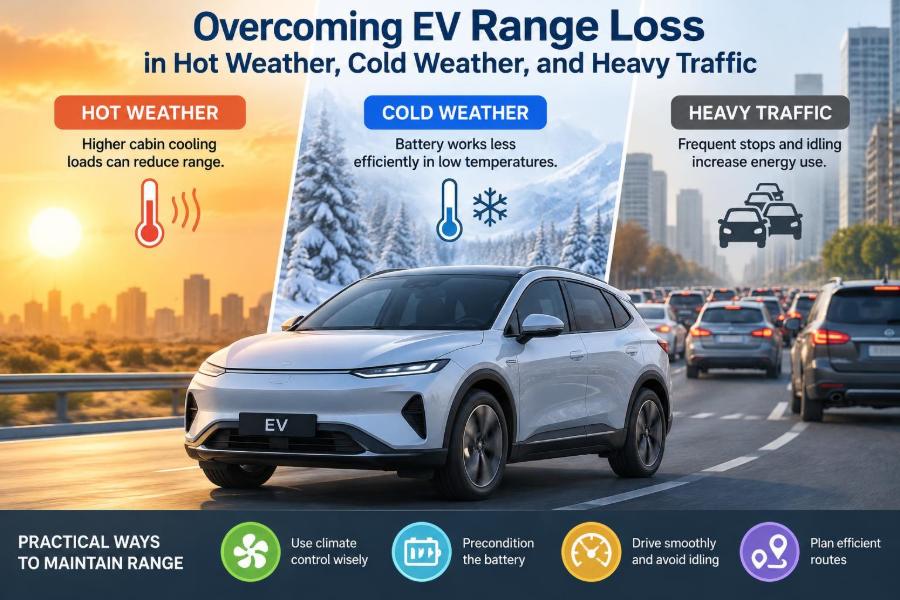
Hot weather, cold weather, and heavy traffic reduce range through different mechanisms. Heat adds cooling loads; cold affects battery behaviour and heating demand; traffic adds time-based auxiliary consumption and repeated acceleration.
The most effective response is a combination of preconditioning, smooth driving, sensible speed, correct tyre care, informed charging stops, and a realistic arrival reserve. None is a universal cure, but together they make range more predictable.
Use the vehicle’s information systems as planning aids, not as reasons for alarm. A changing estimate is often the car accurately responding to changing conditions—and giving the driver time to make a calm adjustment.
EV range is best protected not by sacrificing comfort or safety, but by understanding where energy goes and planning a margin before conditions demand it. 🔋❄️🚗