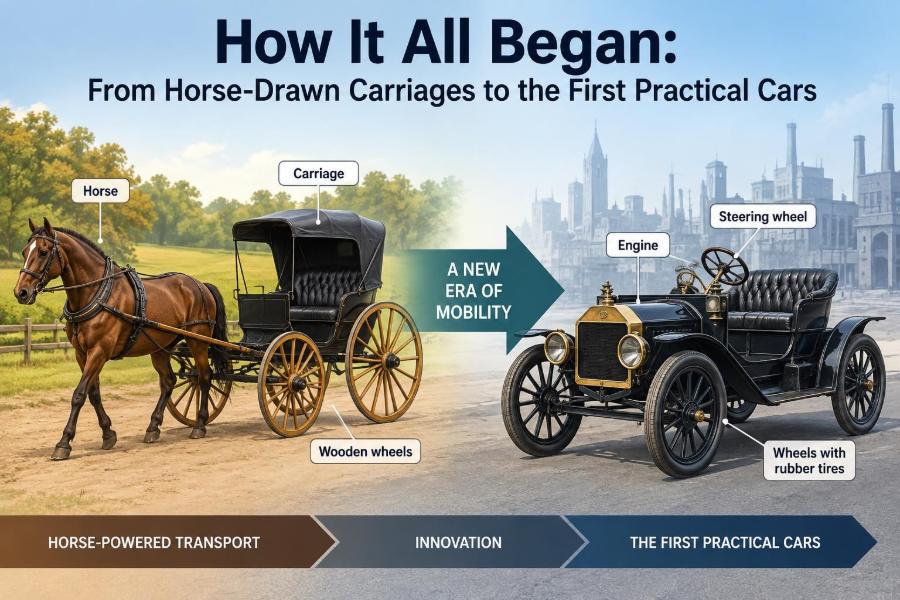

Picture a busy street before the automobile: hooves striking paving stones, delivery wagons edging around pedestrians, and a carriage waiting while its horse rests. For most of human history, this was ordinary transport technology—not a quaint historical scene.
A modern car can feel like a self-contained machine, but many of its basic ideas were inherited from the carriage: wheels, steering, suspension, seating, brakes, and a body designed to carry people or goods. The revolutionary change was not simply adding an engine. It was replacing the living source of power at the front with a controllable mechanical system.
That transition was slow, experimental, and uneven. Steam, electricity, and gasoline all competed; inventors solved one problem only to reveal another; and early motorists had to operate machines on roads built for animals.
Understanding this origin story helps automobile engineering students see why vehicle design is always a compromise between energy, weight, control, reliability, cost, and the needs of real users.
🐎 Transport Before the Automobile
Before self-propelled road vehicles, moving people and freight over land depended mainly on walking, animal power, waterways, and railways. Horses, oxen, mules, and donkeys supplied flexible power where tracks and canals could not reach.
A horse-drawn carriage combined a lightweight body with wheels, axles, springs, a steering arrangement, and a harness system. Its speed and range were limited by the animal’s health, feed, rest, terrain, and weather. Yet it could travel door to door, which made it remarkably useful.
🛞 The Carriage as a Mechanical Starting Point
The early motorcar was often called a “horseless carriage” because that description was mechanically accurate. Builders began with familiar carriage construction and substituted an engine for the horse.
This inheritance explains why many early cars had high wheels, narrow bodies, upright seating, coach-like cabins, and tiller steering. A vehicle needs more than power: it also needs a structure to carry loads, a way to turn, and a way to soften road shocks. Carriage makers already understood much of that craft.
🛣️ Roads Shaped What Was Possible
Road conditions strongly constrained early vehicle design. Many roads were muddy, rutted, dusty, steep, or uneven, while urban streets could be crowded with pedestrians and animal traffic.
Large-diameter wheels helped vehicles roll over rough surfaces. High ground clearance reduced the risk of the underside striking obstacles. These choices could make a car look awkward by modern standards, but they were sensible responses to the infrastructure available.
⚙️ Why Self-Propulsion Was Such a Big Idea
A self-propelled vehicle carries its own energy source and converts that energy into motion. This promised independence from animal endurance and, unlike rail travel, freedom from fixed tracks.
However, self-propulsion created new engineering demands. The vehicle needed to store fuel or energy, regulate power, transmit torque to the wheels, dissipate heat, and remain controllable under changing road loads. A successful car had to make all of these systems work together.
💨 Steam Power Arrived First
Steam engines had already proved their value in mines, factories, ships, and locomotives. Applying steam to road transport seemed like a logical next step, and experimental steam road vehicles appeared well before the practical gasoline car.
A steam vehicle heats water in a boiler to produce high-pressure steam. That steam drives an engine, which turns the wheels through mechanical linkages or gears. The principle was established, but packaging a boiler, water supply, fuel, and engine onto a road vehicle was difficult.
🔥 The Limits of Steam Road Vehicles
Steam could provide useful torque, especially at low speed, but it required time to raise steam before travel. The system also needed regular attention to water level, fuel, pressure, valves, and lubrication.
Weight was another challenge. Boilers and water tanks added mass, which increased road damage and made handling harder. Steam road vehicles continued in specialist roles, particularly heavy haulage, but they were less convenient for the everyday private user envisioned by many inventors.
🔋 Early Electric Cars Offered a Different Answer
Electric vehicles were also serious contenders in the late nineteenth and early twentieth centuries. They were relatively quiet, did not need a hand crank to start, and delivered torque smoothly from rest.
For short urban trips, these characteristics were appealing. But battery technology of the period stored limited energy for its weight, and recharging infrastructure was sparse. Electric cars suited some users well, yet their range and charging constraints made broad adoption difficult outside particular operating patterns.
⛽ The Internal-Combustion Breakthrough
The internal-combustion engine burns fuel inside its cylinders. Expanding combustion gases push a piston, and the piston’s reciprocating motion is converted into rotation at the crankshaft.
This engine type offered a powerful advantage: liquid fuel contained substantial usable energy in a comparatively compact, refillable form. A vehicle could carry enough fuel for a meaningful journey without hauling a boiler and large water reserve.
🧪 From Engine Principle to Usable Machine
An engine principle alone does not produce a practical automobile. Designers needed reliable ignition, controlled fuel delivery, adequate lubrication, cooling, and a durable mechanism that could operate repeatedly without failing.
They also needed manufacturing consistency. A machine that works once in a workshop is an experiment; a machine that starts, runs, stops, and can be repaired by an owner is a product. This distinction separates many early demonstrations from the first practical cars.
🔄 Understanding the Four-Stroke Cycle
Many early gasoline automobiles used the four-stroke cycle. In simplified form, a piston draws an air-fuel mixture into a cylinder, compresses it, receives ignition near the top of its travel, and then expels the exhaust gases.
- Intake: the cylinder fills with a combustible charge.
- Compression: the charge is squeezed to improve the effectiveness of combustion.
- Power: combustion pushes the piston downward.
- Exhaust: spent gases leave so the cycle can repeat.
Only one of these strokes produces power directly, so a flywheel helps smooth the engine’s rotation. This basic cycle became central to automobile development for generations.
🧠 Karl Benz and the Integrated Motor Car
Karl Benz is closely associated with the first practical gasoline-powered automobile because his Patent-Motorwagen was conceived as a motor vehicle rather than simply a carriage fitted with an engine. His work joined chassis, engine, drive system, steering, and control into an integrated design.
The three-wheeled layout avoided some steering complications associated with four-wheel carriages. It was not a finished answer to every transport need, but it demonstrated that a compact internal-combustion vehicle could be purpose-built for road use.
🧭 Bertha Benz Demonstrated Real-World Use
Bertha Benz’s well-known long-distance journey in a Motorwagen was more than a publicity event. It showed that the machine could undertake a meaningful trip outside a controlled workshop environment.
The journey also exposed practical needs: fuel availability, brake wear, steep-gradient performance, and roadside repairs. Early users often became development partners because ordinary travel revealed faults that a short test run could miss.
🏗️ Daimler, Maybach, and Higher-Speed Engines
Gottlieb Daimler and Wilhelm Maybach made major contributions to compact, high-speed internal-combustion engines and their application to vehicles. Their work helped move engine design away from slow stationary machinery toward lighter power units suitable for transport.
Higher engine speed can produce useful power from a smaller engine, but it also raises demands on lubrication, materials, balancing, ignition, and cooling. Their innovations helped establish the engine as a viable vehicle component rather than a bulky add-on.
🇫🇷 French Makers Turned Experiments into Products
French firms and engineers played a major role in converting early inventions into usable automobiles. They developed layouts, transmissions, tyres, bodies, and production practices that made motoring more practical for buyers.
This is a useful correction to the idea that one inventor “created the car” alone. Automobile development was cumulative. Different people and companies improved powerplants, chassis, tyres, controls, manufacturing, and service support.
🧱 The Chassis Had to Carry Every System
The chassis is the vehicle’s structural foundation. In early cars, a ladder-like frame commonly carried the engine, transmission, axles, body, and passengers.
It had to be strong enough to resist bending and twisting on poor roads without becoming excessively heavy. A weak frame could affect steering alignment and reliability; an overly heavy one reduced performance and increased energy use. This trade-off remains fundamental in modern vehicle structures.
⚖️ Power Was Useless Without Transmission
An engine operates efficiently only within a limited speed range, while road vehicles must start from rest, climb hills, cruise, and reverse. The transmission matches engine speed and torque to the needs of the driven wheels.
Early systems used belts, chains, gears, or combinations of these. Gearboxes allowed lower ratios for starting and climbing, with higher ratios for faster travel. The clutch enabled the engine to remain running while the vehicle stopped or while gears were changed.
🔗 Chain Drive, Shaft Drive, and Their Trade-Offs
Chain drive was familiar from bicycles and early machinery. It could be relatively straightforward to arrange, but exposed chains required maintenance and could collect dirt.
Shaft drive enclosed the main power path more effectively and became common in many automobile layouts. Neither solution was automatically superior in every early application; cost, manufacturing capability, vehicle layout, and expected use all influenced the choice.
🧭 Steering Evolved Beyond the Tiller
Many early vehicles used a tiller, similar to the handle used to guide a boat. It was simple, but it became less comfortable and precise as vehicles grew faster and heavier.
The steering wheel, linked through gears and rods to the steered wheels, offered better leverage and a more natural driving position. Steering geometry also mattered. During a turn, the inner wheel must follow a tighter path than the outer wheel, so the wheels should not remain perfectly parallel.
🛑 Stopping Was an Engineering Problem, Too
Early brakes were modest compared with modern systems. Common arrangements acted on wheel rims, drums, or the transmission, often through mechanical levers and rods.
Braking performance depended on friction material, adjustment, tyre grip, road surface, and heat. A vehicle that can accelerate but cannot stop repeatedly and predictably is not practical. This is why braking evolved alongside engine power rather than after it.
🌿 Pneumatic Tyres Changed Comfort and Control
Solid tyres were durable but harsh. On uneven roads, they transmitted shocks to the vehicle and reduced grip over small surface irregularities.
Pneumatic tyres, filled with air, acted as a flexible layer between wheel and road. They improved comfort, traction, and rolling behavior, although punctures became a new maintenance concern. The tyre was not a minor accessory; it transformed what drivers could expect from a road vehicle.
🪜 Suspension Made Rough Roads Manageable
Carriages commonly used leaf springs, and early cars adopted and refined them. Suspension allows the wheels to move over bumps while reducing the disturbance transferred to passengers and the vehicle structure.
Good suspension is not only about comfort. It helps maintain tyre contact with the road, which influences steering, braking, and stability. Early designs were basic, but the underlying engineering goal was already clear: isolate the body while keeping the wheels controlled.
🌡️ Cooling and Lubrication Prevented Early Failures
Combustion engines generate substantial heat, and moving metal parts create friction. Without cooling, components can overheat, distort, or seize; without lubrication, surfaces wear rapidly or weld together under load.
Early engines used methods ranging from simple evaporation arrangements to water circulation. Lubrication systems also progressed from manual attention to more dependable delivery. These unglamorous systems often determined whether a journey ended successfully.
🎛️ Driving an Early Car Required Skill
Early motoring involved far more than selecting a direction and pressing a pedal. Drivers might need to crank the engine, set ignition timing, adjust fuel mixture, manage throttle, choose gears, monitor lubrication, and respond to overheating.
The controls were not standardized. A driver moving from one model to another could encounter unfamiliar lever arrangements and operating procedures. Modern control layouts feel intuitive partly because decades of design gradually standardized what drivers expect.
🧰 Maintenance Was Part of Ownership
An early car owner needed mechanical awareness. Roads could loosen fasteners, tyres could puncture, chains could need adjustment, and ignition or fuel systems could require attention.
Workshops, spare parts, trained mechanics, and fuel retailers developed alongside the vehicle itself. A transport technology becomes practical not only when the machine works, but when people can fuel, maintain, repair, and trust it in daily life.
🏙️ Cities Faced New Benefits and New Problems
Motor vehicles reduced direct dependence on urban horses, whose feeding, stabling, and waste created major logistical burdens in dense cities. Cars and trucks also promised more flexible movement than horse transport.
But they introduced noise, exhaust, crashes, and new demands on streets and traffic management. The automobile did not simply solve a transport problem; it shifted the problem into different engineering, public-health, planning, and safety questions.
📜 Rules Emerged with the Technology
As motor traffic increased, communities developed rules concerning speed, vehicle operation, registration, road behavior, and driver responsibility. The exact approach differed by place and changed over time.
This pattern is still relevant. New vehicle technologies rarely exist outside society; they alter shared spaces, so technical progress must interact with regulation, infrastructure, and public acceptance.
🏭 Manufacturing Changed the Meaning of “Practical”
A hand-built automobile could prove an idea, but it remained expensive and difficult to reproduce. Interchangeable parts and organized production made repairs easier and helped lower the cost of ownership.
Later moving assembly methods dramatically increased output by bringing work to workers in a sequence. The key lesson is that manufacturing engineering helped create mass motoring just as surely as engine design did.
🚙 The Model T and Mass Accessibility
Ford’s Model T became a landmark because it combined a robust design with production methods that enabled much wider ownership than earlier luxury-oriented cars. Its design emphasized durability and suitability for the often rough roads of its era.
It was not the first automobile, nor was it the only influential early car. Its historical significance lies in showing how standardized manufacturing, serviceability, and a well-matched design could turn the automobile from a novelty for a limited group into a broadly useful product.
🔍 What “First Practical Car” Really Means
The phrase first practical car can be misleading if treated as a single, unquestionable title. “Practical” may mean technically self-contained, capable of a real journey, commercially available, reliable enough for ordinary use, or affordable for many buyers.
| Criterion | Question it asks | Why it matters |
|---|---|---|
| Self-propulsion | Can the vehicle move without animal or rail power? | Defines the central technical change. |
| Reliability | Can it operate repeatedly outside a workshop? | Determines real utility. |
| Controllability | Can it steer, stop, and handle varied roads? | Connects power to safe use. |
| Manufacturability | Can similar vehicles be built and supported? | Enables adoption beyond prototypes. |
Using clear criteria produces a more accurate history than searching for one heroic answer.
🧩 Why No Single Inventor Explains the Automobile
The automobile was a systems achievement. Engineers and craftspeople contributed engines, fuel systems, tyres, steering mechanisms, chassis structures, brakes, electrical equipment, production processes, and repair networks.
Giving credit to important pioneers is appropriate, but students should resist oversimplified narratives. Complex technologies emerge through linked improvements, competing designs, failures, and practical feedback from users.
📐 Lessons for Automobile Engineering Students
Early automobile history offers a useful design method. Start with the full use case rather than becoming absorbed in one impressive component. A powerful engine cannot compensate for weak brakes, poor cooling, unreliable tyres, or an unsuitable frame.
- Define the operating environment, including roads, loads, weather, and available service.
- Trace energy from storage to wheels and identify losses at each stage.
- Design for control, stopping, maintenance, and failure modes from the beginning.
- Test beyond the laboratory, because real users reveal different problems.
- Consider production and repairability as engineering requirements, not business afterthoughts.
🔌 The Early Debate Still Echoes Today
The competition among steam, electric, and gasoline vehicles resembles present debates about battery-electric, hybrid, hydrogen, and combustion-powered transport. The technologies differ, but the evaluation questions are familiar.
How much energy can be carried? How quickly can it be replenished? What infrastructure is needed? What are the costs, environmental effects, reliability limits, and best use cases? History does not automatically select a modern winner, but it teaches engineers to evaluate complete systems rather than isolated claims.
🧭 The Core Takeaway: Cars Were Systems Before They Were Icons
The journey from carriage to practical car was not a sudden replacement of horses by engines. It was a gradual integration of a new power source with old vehicle knowledge and newly invented systems for transmission, steering, braking, tyres, cooling, manufacturing, and support.
The most durable engineering lesson is that a vehicle succeeds when its parts work together under real conditions. Performance, safety, affordability, usability, and maintainability must be balanced—not optimized separately.
From the horse-drawn carriage to the first practical cars, automobile history shows that transformative machines are built by solving connected problems, one practical detail at a time. 🚗⚙️🛞