
A familiar commute can produce surprisingly different fuel-use results. One morning, traffic flows and the car seems effortless; the next, a few hard accelerations, a long warm-up, and a search for parking leave the fuel gauge noticeably lower.
That difference is not just about the vehicle’s official rating. Everyday range is shaped by energy losses, driving decisions, maintenance condition, weather, road conditions, and the load being carried.
For petrol, diesel, hybrid, and battery-electric vehicles alike, the basic goal is the same: use less energy to travel each kilometre. The details differ, but the engineering logic is remarkably consistent.
Improving fuel economy is therefore not about driving painfully slowly or ignoring real traffic conditions. It is about reducing avoidable waste while keeping the vehicle safe, reliable, and practical.
🧭 Start with the Meaning of Fuel Economy and Range
Fuel economy describes how much distance a vehicle travels for a given amount of fuel or electrical energy. It may be shown as litres per 100 kilometres, kilometres per litre, miles per gallon, or electrical energy per distance.
Range is the distance available before refuelling or recharging is needed. Better economy usually extends range because the usable energy stored in the tank or battery lasts longer.
A lower litres-per-100-kilometres value is better, while a higher kilometres-per-litre value is better. For electric vehicles, lower energy consumption in kWh per 100 km generally means more range.
⚙️ Follow Where the Vehicle’s Energy Goes
Only part of the energy from fuel or a battery becomes forward motion. An internal-combustion engine also loses substantial energy as heat, exhaust flow, friction, and pumping work. Electric drivetrains are typically more efficient, but still lose energy in motors, electronics, tyres, and accessories.
At the wheels, energy must overcome rolling resistance, aerodynamic drag, drivetrain friction, road gradients, and repeated acceleration. Reducing any one of these demands can improve real-world consumption.
📏 Know Why Official Ratings Differ from Daily Results
Laboratory or certification figures are useful comparisons, but they cannot reproduce every route, climate, payload, tyre condition, or traffic pattern. A short urban trip in cold weather can consume much more energy per kilometre than a steady highway journey.
Use the vehicle’s rated figure as a reference rather than a promise. Your own recorded fuel use over several tanks or charging cycles is a more useful baseline for deciding whether a change has helped.
🧾 Measure Before Trying to Improve
Resetting the trip computer occasionally can reveal how a particular route, season, or driving pattern affects consumption. For a more dependable result in a combustion vehicle, record distance travelled and fuel added over multiple fill-ups.
For an EV, note energy added, distance driven, outside temperature, and use of heating or air conditioning. Charging losses mean energy drawn from the wall can exceed the energy reported as used by the vehicle, so keep the two measures separate.
- Compare similar journeys rather than one exceptional trip.
- Look for persistent trends, not a single unusually good reading.
- Record tyre pressure, cargo, weather, and towing when they change.
🚦 Accelerate Smoothly Rather Than Slowly
Acceleration requires extra energy because the vehicle’s mass must gain speed. That energy is partly recovered by regenerative braking in many hybrids and EVs, but not completely; in conventional vehicles, most of it is ultimately lost as heat during braking.
Smooth, purposeful acceleration is usually preferable to both aggressive launches and excessively hesitant driving that disrupts traffic. Build speed progressively, then settle into a steady load. In an automatic vehicle, moderate throttle often helps it select an efficient gear without forcing an unnecessary downshift.
👀 Look Far Ahead to Avoid Unnecessary Braking
Anticipation is one of the most effective everyday habits. Watch traffic several vehicles ahead, read signal timing where possible, and ease off early when a queue is clearly developing.
Arriving at a red light more slowly can be better than accelerating toward it and braking hard. The aim is not to coast through hazards or ignore rules; it is to preserve momentum when the road is clear and stopping is not required.
🛣️ Keep Highway Speed in Perspective
Aerodynamic drag rises rapidly as speed increases. The power required to push through air rises even more sharply, so a modest reduction in high-speed cruising speed can noticeably improve consumption and EV range.
This effect is especially clear on exposed motorways, in headwinds, and in tall vehicles. Drive at a legal speed that suits conditions, leave adequate following distance, and use cruise control thoughtfully rather than treating it as a reason to maintain speed on every steep hill.
🌬️ Understand Aerodynamic Drag
Air resistance depends on vehicle shape, frontal area, air density, and speed. Roof racks, roof boxes, open windows at higher speeds, external accessories, and a trailer can all increase drag.
A roof box may be worthwhile when its carrying capacity is genuinely needed, but leaving it fitted all year creates a continuous penalty. Remove external carriers when not in use, and keep windows closed at highway speed if cabin comfort allows.
🛞 Maintain Correct Tyre Pressure
Underinflated tyres flex more as they roll. That flexing generates heat and increases rolling resistance, the force required to keep tyres moving along the road.
Check pressures when tyres are cold and use the manufacturer’s recommended values for the actual load and speed condition. The number moulded on a tyre sidewall is normally a maximum rating, not the target pressure for the vehicle.
Overinflating tyres merely to chase economy can reduce ride quality and may compromise the intended contact patch and handling. Correct pressure is the efficient and safe choice.
🧰 Choose Tyres for Their Real Job
Tyre design involves trade-offs among grip, wet braking, noise, wear, ride, and rolling resistance. A low-rolling-resistance tyre can reduce energy demand, but it must still be the correct size, load rating, speed rating, and suitability for the climate.
Wheel alignment also matters. If wheels point slightly in the wrong directions, tyres scrub across the road rather than rolling cleanly. Uneven wear, a steering wheel that is off-centre, or a vehicle that pulls can justify an alignment inspection.
🎒 Remove Weight You Do Not Need
Extra mass raises the energy needed for acceleration and hill climbing. It has a greater effect in stop-start driving than during steady cruising, where aerodynamics often dominate.
Clear out heavy tools, sports equipment, or cargo that no longer needs to be in the vehicle. However, do not remove required safety equipment, the spare wheel where appropriate, or tools necessary for a planned trip simply to save a small amount of energy.
⛰️ Plan for Hills, Wind, and Surface Conditions
Climbing converts vehicle energy into gravitational potential energy. Descending returns only some of it in a hybrid or EV through regeneration; a combustion vehicle generally dissipates much of it through engine braking and wheel brakes.
Headwinds act much like increased driving speed, while wet, rough, loose, or soft surfaces increase resistance. A route that is slightly longer but avoids severe congestion, repeated steep climbs, or poor surfaces can sometimes use less energy, though this should be checked rather than assumed.
🗺️ Choose Routes That Reduce Waste
Navigation should not be used only to find the shortest distance. Consider predictable delays, school-zone traffic, roadworks, road gradient, charging availability, and safe opportunities to merge or turn.
A very short route with ten stop signs may be less efficient than a slightly longer road with smooth flow. On the other hand, a long detour merely to avoid a few traffic lights may consume more fuel. Route planning works best when based on recurring patterns.
🔁 Reduce Idling and Unnecessary Warm-Up
An idling combustion engine uses fuel while producing no distance. Modern engines generally do not need a long stationary warm-up; gentle driving after starting is usually a more practical way to bring the drivetrain toward operating temperature.
Stop-start systems can reduce idling in suitable traffic, although they may not activate when the engine is cold, the battery state is low, or cabin-conditioning demand is high. If stopping is prolonged and it is safe and lawful to do so, switching off may save fuel.
Electric vehicles do not idle in the same combustion sense, but climate control and electronics still consume stored energy while parked.
🌡️ Manage Heating, Cooling, and Demisting
Cabin comfort uses energy. In a combustion vehicle, cabin heat can partly use engine waste heat once warm, but air conditioning places an additional load on the engine. In an EV, resistive heating can have a notable range effect because heat must come from the battery.
Preconditioning an EV while it remains plugged in can warm or cool the cabin and, where supported, condition the battery before departure. Use it sensibly: clear windows fully, prevent driver fatigue, and never compromise visibility to save energy.
❄️ Expect Cold Weather to Change Range
Cold air is denser, increasing aerodynamic drag. Tyre pressures can fall as temperature drops, lubricants are thicker when cold, and occupants demand heat and demisting.
Battery performance and charging behaviour can also change in low temperatures. This does not mean winter driving is problematic by default, but it does mean planning margins should be larger, especially on short trips or long journeys where charging stops are limited.
🔋 Use Regenerative Braking Well
Regenerative braking turns the drive motor into a generator during deceleration, sending some kinetic energy back to the battery. It is particularly useful in urban traffic and on descents.
Regeneration cannot recover all energy because conversion losses exist, battery acceptance can be limited, and friction brakes may still be needed. A nearly full battery or a cold battery may accept less regenerative energy. The best sequence remains: avoid needless acceleration, then use controlled deceleration to recover what is available.
⚡ Drive an EV with Battery Limits in Mind
For electric vehicles, efficient driving means managing both energy consumption and charging strategy. High speed, heavy cabin heating, headwinds, and towing can shorten practical range, so the display’s predicted range should be treated as an estimate shaped by recent conditions.
On a long trip, a slightly slower cruising speed may reduce energy use enough to shorten the overall journey by reducing charging time. The best approach depends on charger locations, charging speed at different battery states, traffic, and the vehicle’s own charging curve.
🔌 Avoid Treating Every Charge as the Same
Battery-electric vehicles usually charge fastest only within part of their state-of-charge range. Charging may slow substantially near a very high state of charge, particularly on rapid chargers.
For routine use, follow the vehicle manufacturer’s guidance on charge limits and battery care. Before a long journey, a higher charge may be appropriate for range. The practical objective is enough energy for the trip and a sensible reserve, not a rigid rule applied to every situation.
🧪 Use the Right Fuel and Fluids
Use the fuel grade specified by the manufacturer. A higher-octane petrol fuel is not automatically more economical if the engine is not designed or calibrated to benefit from it; octane primarily indicates resistance to knock, not energy-saving quality.
Correct engine oil, transmission fluid, coolant, and lubricants help components operate as designed. Using an unapproved viscosity or fluid can affect efficiency, durability, and warranty considerations. Follow the owner’s manual rather than relying on generic advice.
🔧 Keep the Engine and Drivetrain Healthy
A poorly maintained vehicle can waste energy through faults such as sticking brakes, contaminated air filters where applicable, worn spark plugs, injector problems, malfunctioning sensors, or transmission issues. A warning light should not be ignored simply because the car still drives normally.
Maintenance does not create miraculous economy beyond the vehicle’s design, but it restores intended performance and can prevent a gradual decline from going unnoticed.
- Follow the scheduled service intervals.
- Investigate fuel smells, rough running, unusual smoke, or reduced power.
- Check for brake drag if a wheel becomes unusually hot after normal driving.
- Address tyre wear and alignment issues early.
🧠 Select Gears Intelligently in Manual Vehicles
In a manual-transmission vehicle, shifting up at an appropriate point can keep engine speed moderate under light load. But selecting too high a gear at low speed can make the engine labour, causing vibration and poor response.
The efficient gear is the one that lets the engine pull smoothly with enough reserve for the situation. Downshift before a hill, overtaking manoeuvre, or acceleration demand rather than pressing the throttle deeply in an unsuitable high gear.
🤖 Use Automatic Modes with Understanding
Modern automatic, dual-clutch, and continuously variable transmissions are designed to select efficient ratios under many conditions. Normal or eco modes may soften throttle response, alter shift strategy, reduce climate-control demand, or limit performance features.
These modes are tools, not magic. If an eco mode makes a driver hesitate unsafely while joining fast traffic, use an appropriate mode and prioritise control. Conversely, a sport mode may hold lower gears and increase consumption when its sharper response is unnecessary.
🚚 Recognise the Cost of Towing and Carrying Loads
Towing adds mass and often substantial aerodynamic drag. A trailer, caravan, or rear-mounted load can alter acceleration, hill-climbing demand, stability, braking distance, and energy use.
Check towing limits, tyre pressures, load distribution, and legal requirements. For EV trips, plan charging more conservatively because some charging sites may be difficult to access with a trailer attached.
🚧 Do Not Chase Economy at the Expense of Safety
Some so-called fuel-saving practices are unsafe or illegal. Coasting downhill in neutral removes engine braking and can reduce control. Drafting closely behind a truck is dangerous, reduces visibility, and provides no acceptable safety margin.
Similarly, switching off the engine while moving, disabling safety systems, or driving with compromised demisting is not responsible efficiency. Good economy comes from anticipation, maintenance, and sensible planning—not from taking risks.
📊 Separate Useful Habits from Popular Myths
| Claim | More accurate view |
|---|---|
| “Premium fuel always saves money.” | Only use a higher grade when the manufacturer specifies or recommends it for the engine’s calibration. |
| “The lightest possible tyre pressure is comfortable and harmless.” | Low pressure raises rolling resistance and can harm handling and tyre life. |
| “Regeneration makes hard braking free.” | It recovers only part of the energy; avoiding needless speed changes remains better. |
| “Cruise control is always most efficient.” | It can help on level roads but may hold speed inefficiently over rolling terrain. |
🧮 Make a Simple Personal Economy Plan
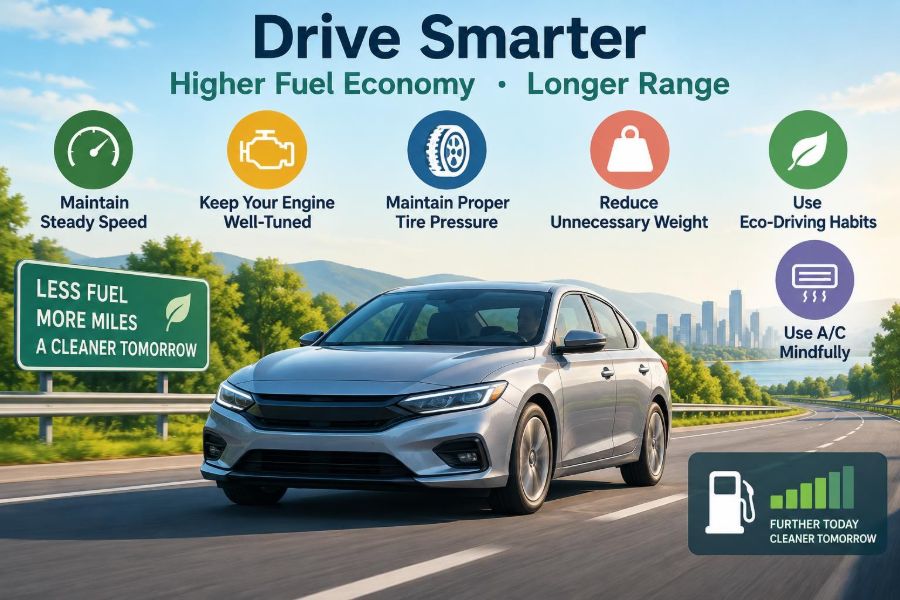
Choose two or three changes that fit your routine, then observe results over time. For example, a commuter might check tyre pressure monthly, remove an unused roof rack, and begin easing off early for a known traffic signal.
Changing everything at once makes it difficult to know what worked. A small, repeatable process is more valuable than an ambitious plan that disappears after a week.
- Establish a baseline across ordinary journeys.
- Fix maintenance or tyre issues first.
- Change one driving or planning habit.
- Review the trend after enough comparable driving.
- Keep the changes that improve efficiency without reducing safety or convenience.
🏁 Bring the Principles Together
The core principle is straightforward: fuel economy improves when the vehicle wastes less energy on drag, tyre deformation, excess mass, idling, harsh speed changes, and mechanical faults. Range extends when that lower energy demand is matched with realistic route and climate planning.
There is no single trick that suits every vehicle and journey. Highway drivers gain most from managing speed and aerodynamic drag; urban drivers benefit heavily from anticipation and reduced idling; EV drivers also need to consider battery temperature, accessory loads, and charging strategy.
The most durable gains come from habits that are calm, safe, and easy to repeat. They also tend to reduce wear on tyres, brakes, and drivetrain components, which makes efficient driving a broader ownership practice rather than a fuel-gauge exercise.
Drive smoothly, maintain the vehicle correctly, and plan for real conditions: that is the most reliable way to use less energy and travel farther on every tank or charge. 🚗🔋🛣️