
You are approaching a junction on a wet road when the traffic ahead slows more quickly than expected. Your foot moves to the brake pedal, and within a moment the car settles down and loses speed in a controlled, predictable way.
That ordinary event depends heavily on what happens at the front wheels. Although every wheel contributes to stopping the vehicle, the front brakes normally do the largest share of the work.
Look through the alloy wheel of most modern cars and you will see a metal disc clamped by a caliper. At the rear, depending on the vehicle, you may find another disc or a traditional enclosed drum brake.
The reason for this layout is not fashion. It is a practical response to weight transfer, heat, water, control, service needs, and the way a car behaves during hard braking.
🛑 The short answer: front brakes work hardest
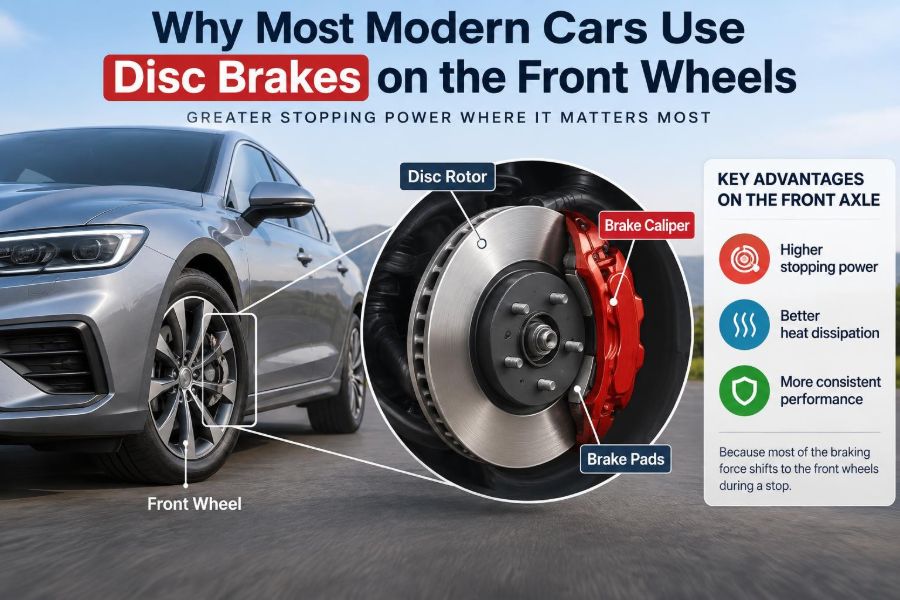
Most modern cars use disc brakes on the front wheels because braking shifts load toward the front axle. The front tyres are then pressed harder into the road and can generate more braking force before they lose grip.
Front brakes must therefore deal with the highest mechanical loads and usually the greatest heat. Disc brakes are particularly well suited to this demanding job because they cool quickly, resist performance changes after repeated stops, and are easy to control precisely.
Rear disc brakes are also common, especially on larger, faster, heavier, or more premium vehicles. But a rear drum brake can still be an effective and economical choice where the rear axle has lower braking demand.
🚙 A car’s weight does not stay still during braking
When a moving car decelerates, its mass resists the change in motion. Relative to the car, the body tends to pitch forward. This is called longitudinal weight transfer.
The car has not suddenly gained mass at the front. Instead, the vertical load carried by the front tyres rises while the load on the rear tyres falls. The effect becomes more pronounced with harder braking, a higher centre of gravity, and a shorter wheelbase.
A braking system should use this changing tyre load intelligently. If the rear brakes apply too much force, the lighter-loaded rear tyres can lock before the fronts, making the car unstable.
📐 Why the front axle gains braking capacity
A tyre can transmit only a limited force to the road. In simple terms, a tyre carrying more vertical load usually has more available grip, although the relationship is not perfectly proportional in real tyres.
During a substantial stop, the front axle gains enough load that it can safely produce much more braking force than the rear axle. Engineers call the desired front-to-rear distribution brake bias.
Brake bias is not fixed by one component alone. It is shaped by vehicle weight distribution, suspension geometry, tyre characteristics, centre-of-gravity height, and the hydraulic system. Yet the basic result is consistent: the front brakes require greater capacity.
🧲 What a disc brake actually does
A disc brake uses a rotating iron or steel rotor, usually called a brake disc, attached to the wheel hub. A caliper straddles the disc and holds friction pads on each side.
When the driver presses the pedal, hydraulic pressure pushes pistons in the caliper. The pads squeeze the disc, creating friction that turns the vehicle’s kinetic energy into heat.
The tyre-road contact patch ultimately slows the car, not the brake rotor alone. The brake creates torque at the wheel; the tyre transfers that braking force to the road. If the tyre has insufficient grip, it can slide regardless of how powerful the brake hardware is.
🥁 How a drum brake differs
A drum brake has a rotating drum shaped like a shallow metal cylinder. Inside it, curved brake shoes are forced outward against the drum’s inner surface.
Drum brakes are compact and can generate strong braking torque with relatively modest hydraulic force. Their enclosed design also makes it easy to incorporate a mechanical parking brake.
However, the friction surfaces are less exposed to air. When a drum repeatedly absorbs large amounts of energy, heat has a harder time escaping. This is the central reason drums are less attractive for the heavily loaded front axle of a modern road car.
🔥 Braking is an energy-management problem
A car in motion contains kinetic energy. The faster it travels, the more energy its brakes must absorb, and the energy rises rapidly as speed increases. Vehicle mass matters too: a loaded car asks far more of its brakes than the same car with only a driver aboard.
On a long descent or during repeated high-speed stops, the brake system cannot simply make heat disappear. It must store heat temporarily and release it to the surrounding air.
Because the front brakes handle a larger share of the work, they need generous thermal capacity and efficient cooling. An exposed disc gives engineers an effective platform for both.
🌬️ Open discs shed heat efficiently
A disc rotates openly in the airflow behind the wheel. Its two broad faces and outer edge can release heat directly to the passing air. The caliper and pads are accessible to cooling air as well.
Many front discs are ventilated. They contain internal vanes between two friction faces, creating air passages that pump air through the rotor as it turns. This increases heat rejection without making the disc excessively thick or heavy.
A drum has a larger enclosed chamber around its friction surfaces. It can still cool, but generally not as readily under severe repeated use. For front brakes, that difference is highly valuable.
🌡️ Heat changes how brakes feel and perform
Excessive brake temperature can affect several parts at once. Pad friction characteristics may change, the disc can develop uneven deposits or distortion-related vibration, and brake fluid near hot calipers can be stressed.
Drivers often use the word fade for any reduced braking confidence, but several phenomena can be involved. Pad fade means the friction material works less effectively at excessive temperature; fluid boiling can create a soft pedal because vapour compresses; and overheated surfaces can feel inconsistent.
A disc system does not make overheating impossible. It simply gives the front axle a much better chance of controlling temperatures during normal severe use, especially compared with a similarly sized enclosed drum.
💧 Wet-weather recovery is another disc advantage
Water can form a thin film between friction surfaces and temporarily reduce initial braking response. With a disc brake, the pads sweep across exposed rotor faces and can clear water quickly.
This does not mean wet roads are harmless. Tyre grip is still reduced, puddles can affect handling, and stopping distances may grow. But the brake’s friction interface tends to recover rapidly after being wet.
Drum brakes are more enclosed, so water that enters can take longer to leave or dry. This was a more noticeable practical limitation when drum brakes were common on front axles.
🎯 Disc brakes offer predictable modulation
Modulation means the driver’s ability to adjust braking force smoothly and accurately. A good brake system lets a small change in pedal effort produce a controlled, understandable change in deceleration.
Disc brakes generally provide a stable and linear feel because the caliper clamps directly onto a flat rotating surface. The pad retracts only a very small distance when pressure is released, so response is prompt on the next application.
That predictability matters in everyday traffic, on changing surfaces, and during emergency braking. It also gives electronic control systems a responsive foundation from which to manage individual wheel pressure.
⚙️ The self-energizing trait of drum brakes
Many drum brake designs have a self-energizing or self-servo effect. As the drum rotates, it can pull a leading shoe into tighter contact, multiplying braking force.
This is useful because it reduces the hydraulic force needed for a given braking torque. It is one reason drum brakes remain viable at the rear of lighter and lower-cost vehicles.
The trade-off is that the effect can vary with direction of rotation, shoe condition, temperature, and adjustment. Disc brakes do not depend on this self-energizing action, which contributes to their more consistent response under demanding front-axle conditions.
🧠 Front discs work well with ABS
The anti-lock braking system, or ABS, monitors wheel speeds and reduces then reapplies brake pressure when a wheel is close to locking. Its purpose is to help preserve steering control during heavy braking on surfaces with available grip.
Because the front wheels also steer the vehicle, maintaining their rotation is especially important. A locked front wheel cannot provide useful directional control in the normal way.
Disc calipers can build and release hydraulic pressure quickly, supporting the rapid control cycles used by ABS. Modern systems are designed as complete vehicle systems, so this is not a claim that discs alone create ABS performance; rather, their responsive behavior fits the application well.
🛞 Steering and braking meet at the front tyres
The front tyres often have two major jobs at once: slowing the vehicle and changing its direction. A tyre has limited total grip, so hard braking while cornering requires careful sharing of available traction.
This is sometimes illustrated by the friction-circle concept. It is not a literal fixed circle for every tyre and condition, but it communicates a useful truth: asking for more braking leaves less capacity for cornering, and vice versa.
Strong, controllable front disc brakes help the driver and stability systems manage this demanding operating area. They cannot override physics, but they allow braking force to be applied with accuracy.
⚖️ Brake bias protects straight-line stability
Manufacturers intentionally bias most passenger-car braking effort toward the front. The aim is for the front tyres to approach their grip limit before the rears in a hard stop, while ABS manages the margin near lock-up.
If rear tyres lock first, the rear of the vehicle may try to overtake the front, particularly on a low-grip surface or while turning. This is why simply fitting more aggressive rear brakes without engineering the whole system can be hazardous.
Hydraulic sizing, pad friction, rotor diameter, electronic brake-force distribution, suspension movement, and tyre selection all influence final balance. Brake upgrades are not safely judged by appearance alone.
🔩 Larger front hardware is not just for looks
Front rotors are often wider, larger in diameter, or ventilated when rear rotors are solid and smaller. Larger diameter increases the leverage at which the caliper acts on the wheel, while greater mass and surface area help handle heat.
Front calipers may also use larger pistons or multiple pistons. More piston area can create more clamp force for a given hydraulic pressure, although pedal feel and total system balance must be designed around it.
Visible large front brakes behind wheels can look sporty, but their real purpose is functional: they provide the torque and thermal margin required by the front axle.
🏗️ Vehicle mass and use change the design
A small commuter hatchback, a family SUV, a battery-electric vehicle, and a towing-capable pickup do not need identical braking hardware. Mass, payload, tyre size, aerodynamic drag, intended speed range, and expected duty cycle all matter.
Heavier vehicles generally need more thermal capacity because each stop involves more energy. Vehicles expected to descend hills while loaded or tow trailers face additional demands, especially when drivers use brakes repeatedly instead of selecting an appropriate lower gear or drive mode.
Even so, the front axle remains the primary braking axle in most conventional layouts. The exact split changes with loading and deceleration, which is why control systems continuously adjust pressure.
🔋 Regenerative braking does not remove the need for front discs
Hybrid and electric vehicles can use their traction motors as generators during deceleration. This regenerative braking converts some motion back into electrical energy and sends it to the battery.
Regeneration can reduce friction-brake use in routine driving, but it is limited by battery condition, motor capability, speed, traction, and requested deceleration. Mechanical friction brakes remain necessary for strong stops, low-speed stopping, emergency situations, and backup capability.
Many electrified vehicles still use front disc brakes because the same weight-transfer and peak-braking principles apply. Their rotors may see less routine use, creating a different maintenance concern: corrosion can become more significant in damp or salty climates.
🧰 Why some cars retain rear drum brakes
Rear drums have not disappeared because they are inherently unsafe or obsolete. On an axle with lower braking demand, they can provide adequate performance, durability, and a cost-effective integrated parking brake.
They are also well protected from road debris, and their self-energizing action can be useful for parking-brake force. For a vehicle designed mainly for ordinary commuting, these benefits can outweigh the thermal advantage of rear discs.
The front axle is different. Its much higher energy load makes disc brakes the more natural choice on almost every modern passenger vehicle, regardless of whether the rear axle uses discs or drums.
🅿️ The parking-brake design question
A parking brake must hold a stationary vehicle without relying solely on hydraulic pressure. In a rear drum system, a cable or electric actuator can spread the brake shoes directly inside the drum.
Rear disc systems use several solutions. Some calipers contain a mechanical parking-brake mechanism, while others use a small separate drum built into the centre of the rear rotor, sometimes called a drum-in-hat arrangement.
This packaging issue helps explain why rear-brake choices are more varied. It does not change the basic front-brake argument, since parking brakes almost always act at the rear wheels.
🧪 Pads and rotors are engineered as a matched system
Brake pad compounds balance cold bite, high-temperature behavior, noise, dust, wear, rotor compatibility, and cost. A pad that feels very sharp when cold may not necessarily be best for quiet, long-lived family-car use.
Rotors are selected for material properties, cooling design, thickness, mass, and resistance to fatigue under repeated temperature cycles. Caliper stiffness and piston seals also influence feel and durability.
For this reason, replacing pads with an unsuitable aftermarket compound can change noise, pedal response, rotor wear, or braking balance. The best choice is usually a quality part specified for the vehicle’s intended road use, not simply the most aggressive-sounding option.
🔧 Service access is simpler with discs
Disc brake inspection is straightforward. Through the wheel or after removing it, a technician can usually see pad thickness, rotor condition, hose routing, and caliper hardware.
Pad replacement generally involves removing the caliper or its mounting arrangement, retracting the piston, and fitting new pads with the correct clips and lubricant at approved contact points. The process still requires proper procedure, clean surfaces, and correct tightening torque.
Drum brakes can be reliable for long periods, but their internal shoes, springs, adjusters, and parking-brake parts require more disassembly to inspect. This service convenience is a secondary, but genuine, advantage for front discs.
👂 Common noises are clues, not diagnoses
A brief squeal in damp conditions can occur as surface moisture or light corrosion is cleared from a rotor. It is not automatically a sign of dangerous failure.
Persistent squealing, grinding, a scraping noise, steering-wheel vibration during braking, pulling to one side, a warning light, or a soft pedal deserves prompt inspection. These symptoms can arise from worn pads, seized caliper slides, uneven deposits, damaged hardware, hydraulic issues, or problems unrelated to the friction material.
Do not assume that a noisy brake merely needs spray lubricant. Applying unsuitable products to pads, discs, or tyre-contact areas can seriously reduce braking performance.
📏 Rotor thickness and runout matter
Brake rotors have a minimum permitted thickness specified by the vehicle manufacturer. As pads wear, the rotor also gradually loses material. A rotor below its limit may overheat more easily and may not support correct caliper operation.
Runout is the side-to-side wobble of the rotor as it turns. Excessive runout, hub corrosion, poor mounting cleanliness, or uneven friction deposits can contribute to pedal pulsation and vibration.
Replacing parts without cleaning the hub face or checking the underlying cause can allow the problem to return. Accurate diagnosis is more valuable than changing components by habit.
🧼 Corrosion can affect lightly used brakes
Cars that sit for long periods, travel mainly short distances, or operate in wet and salted environments may develop rotor corrosion. A light surface film often clears after a few normal brake applications.
Heavier corrosion can create roughness, noise, uneven braking, or pad damage. Electrified cars deserve particular attention because regenerative braking may reduce friction-brake use during everyday driving.
Following the manufacturer’s maintenance guidance and having brakes inspected at scheduled services is sensible. A driver should not perform harsh repeated stops on public roads as an improvised cure for a suspected brake problem.
🚫 Bigger brakes are not automatically better
A larger rotor or multi-piston caliper can be useful in a properly engineered package, especially where repeated high-energy braking is expected. But it does not automatically shorten a single emergency stop on ordinary tyres.
For one hard stop, tyre grip, road surface, vehicle stability, and ABS control are often the limiting factors. Oversized hardware can add unsprung mass, affect wheel fitment, upset brake bias, or create compatibility problems with master cylinders and electronic systems.
Meaningful modifications require vehicle-specific engineering knowledge. For most road cars, correctly maintained original-equipment-size brakes are the safer and more rational choice.
🛣️ Driving habits still protect the front brakes
Even excellent front discs can be overloaded by poor technique. On long descents, use an appropriate lower gear, selected drive mode, or manufacturer-recommended hill-descent feature where available, rather than holding continuous light brake pressure.
Leave space in traffic so braking can be gradual. Anticipating slowing traffic reduces heat, pad wear, and fuel or energy use while making the ride smoother for passengers.
After exceptionally hard use, avoid stopping with the brake pedal held firmly for a prolonged period if conditions permit; hot pads pressed against a stationary rotor can sometimes contribute to uneven material transfer. Normal safe parking practice always takes priority.
🧯 When brake symptoms require immediate attention
Some brake concerns should not wait for a routine service appointment. A brake warning light, a major loss of pedal firmness, a vehicle that pulls strongly while braking, a burning smell with unusually hot wheel area, or grinding that continues with braking can indicate a serious fault.
Safely reduce speed, avoid unnecessary driving, and arrange qualified inspection. If braking response is significantly reduced, stopping the vehicle in a safe place and seeking assistance is the prudent response.
Brake systems are safety-critical. Visual checks can be useful, but repairs involving hydraulic components, electronic parking brakes, or uncertain faults should be handled by a competent technician with the right information and tools.
🔍 A practical inspection checklist
During routine maintenance, a proper brake check looks beyond pad thickness. The goal is to find uneven wear and the causes behind it before performance is affected.
- Check pad thickness and compare inner and outer pads where visible.
- Inspect rotors for deep scoring, cracking, severe corrosion, and abnormal lips.
- Examine caliper slides, boots, hoses, and visible fluid leaks.
- Confirm that brake-fluid service follows the vehicle manufacturer’s interval and specification.
- Pay attention to new noises, vibration, pulling, warning lights, or changes in pedal feel.
These checks support reliability, but they do not replace the manufacturer’s workshop procedure or professional diagnosis when faults are present.
📊 Front discs and rear drums at a glance
| Feature | Front disc brake | Rear drum brake in a typical passenger car |
|---|---|---|
| Usual braking demand | High because of forward weight transfer | Lower in most hard stops |
| Cooling | Strong, especially with ventilated rotors | More limited due to enclosed construction |
| Wet recovery | Generally quick | Can be slower after water enters |
| Service access | Pad and rotor condition often easy to inspect | Internal parts require drum removal |
| Parking-brake integration | Requires a built-in mechanism or separate arrangement | Naturally suited to a mechanical parking brake |
| Common role | Standard on the front axle of modern cars | Still practical on some rear axles |
🧭 The design is a system, not a single part
It is tempting to credit the front disc alone for a car’s stopping ability. In reality, braking performance comes from an integrated system: tyres, suspension, wheel alignment, hydraulic circuits, brake hardware, ABS, stability control, vehicle loading, and driver input all interact.
A worn tyre can compromise stopping on wet pavement even if the discs and pads are new. A poorly maintained caliper can compromise a high-quality rotor. And no brake system can create grip where ice, loose gravel, or standing water has sharply reduced it.
Front disc brakes are a key part of the system because they address the axle where braking demand is greatest, but they are not a substitute for maintaining every related component.
✅ The core principle behind front disc brakes
Modern cars place disc brakes at the front because braking transfers load forward, allowing the front tyres to generate most of the available braking force. That forces the front brakes to absorb the greatest energy and operate reliably under the harshest thermal conditions.
Disc brakes meet those needs with open cooling surfaces, available ventilated designs, rapid wet recovery, controllable clamp force, and practical compatibility with modern brake-control systems. Rear drums remain useful in appropriate applications, but their strengths align more naturally with the lower-demand rear axle.
The arrangement is therefore a carefully balanced engineering decision rather than a simple convention. It reflects the physics of deceleration and the need to give drivers stable, repeatable control when it matters most.
Front disc brakes dominate modern cars because the front axle carries the biggest braking load, and discs manage that load with effective cooling, predictable control, and dependable everyday performance. Keep the whole braking system maintained, including tyres, fluid, and rear brakes—not only the parts visible through the front wheels. 🚗🛑🔧