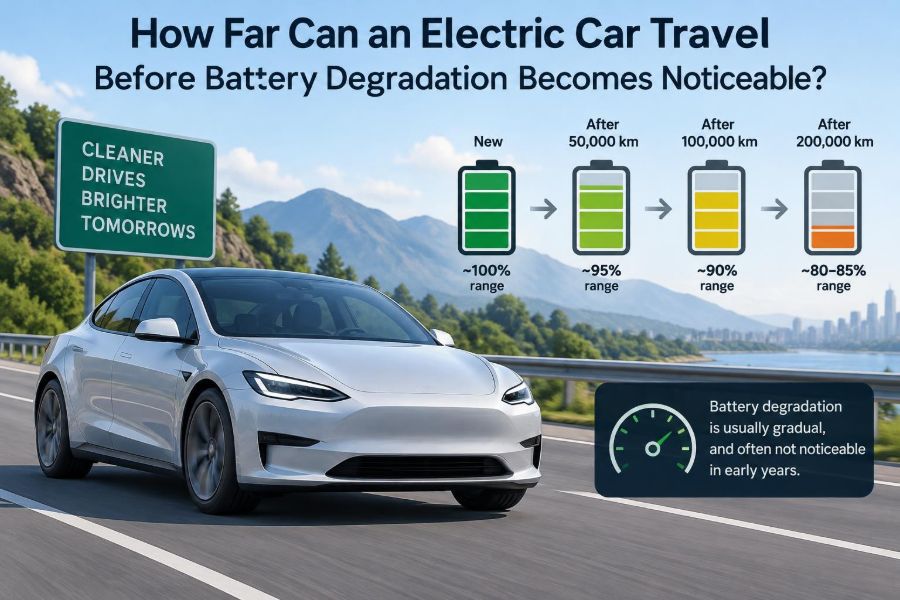

A new electric car can feel wonderfully predictable. The dashboard suggests a familiar range, the charging routine becomes second nature, and a commute that once involved fuel stops becomes a quiet journey home to a charger.
Then, perhaps after a few years, the estimated range looks slightly lower than it used to. A winter trip needs an extra charging stop, or the car seems to lose charge faster on a steep motorway climb. Is the battery wearing out—or is something else affecting the number?
That question matters to drivers planning long ownership, fleet managers calculating operating costs, and students learning how battery systems behave outside a laboratory. An EV battery does not usually fail suddenly; it changes gradually, under the combined influence of age, temperature, charging habits, and use.
The useful question is therefore not simply how many kilometres an EV can travel before degradation starts. It is when the loss becomes noticeable in real driving, and what owners can realistically do about it.
🔋 What Battery Degradation Actually Means
Battery degradation is the gradual reduction in a battery pack’s ability to store and deliver energy. In an electric car, it is usually discussed as a decline in usable energy capacity, although increased internal resistance can also reduce performance.
A pack that originally supplied 70 kWh of usable energy may, after years of service, supply somewhat less. If the car’s energy consumption stays similar, its driving range falls in roughly the same proportion.
Degradation is not the same as an empty battery. Charging restores energy for the next journey; degradation changes the amount of energy the battery can hold in the first place.
📏 Range Loss Is More Visible Than Capacity Loss
Drivers rarely measure battery capacity directly. They notice the consequences: fewer kilometres between charges, less reserve at the end of a regular trip, or a changed charging pattern on a holiday route.
For example, a car that normally covers 400 km in mild conditions could lose 5% of its usable capacity. In comparable conditions, that could mean roughly 20 km less range. Some drivers will barely register that difference; others may notice it immediately if their daily route already sits close to the car’s limit.
This is why there is no universal mileage at which degradation becomes noticeable. The threshold depends on the vehicle, the route, climate, and the driver’s expectations.
🧪 Inside the Lithium-Ion Cell
Most modern EVs use lithium-ion cells. During discharge, lithium ions move through an electrolyte from one electrode to the other, while electrons travel through the external circuit to power the motor. Charging reverses this movement.
Repeated movement is normal, but side reactions slowly consume active lithium or change electrode materials. A thin protective layer called the solid electrolyte interphase, or SEI, forms mainly on the negative electrode. It is necessary for stable operation, yet it can grow over time and use up lithium that would otherwise carry charge.
Cell chemistry, electrode design, cooling, and software controls all influence how quickly these processes occur. That is why two EVs with similar advertised range may age differently.
🔄 Calendar Aging and Cycle Aging
Battery aging has two overlapping causes. Calendar aging occurs simply as time passes, even if the car is driven very little. Temperature and the state of charge at which the pack spends its time strongly affect it.
Cycle aging comes from energy moving in and out of the battery. A cycle does not have to mean one complete 100% discharge followed by a 100% recharge. Several partial charges and discharges that add up to the battery’s usable energy can be treated as approximately one equivalent full cycle.
A lightly used EV stored for years in a hot place can still lose capacity. Conversely, a frequently driven vehicle with effective thermal management and sensible charging may retain useful range very well.
🛣️ Distance Is an Imperfect Predictor
Odometer distance is easy to compare, but it is only a proxy for battery use. Two cars showing the same mileage may have experienced very different battery lives.
One may have spent most of its life on gentle urban routes, charged slowly overnight, and parked in a temperate garage. The other may have operated as a high-speed taxi, rapid-charged repeatedly, and sat outdoors through very hot summers.
Distance can indicate likely cycle exposure, but it cannot reveal calendar aging, heat history, charging patterns, or how much of the original capacity the manufacturer deliberately kept as a protective reserve.
📉 When Does the Change Become Noticeable?
There is no fixed point, but a small early change may be hidden by normal variation in weather, speed, tyre pressure, and driving style. Many drivers only become confident that degradation is present when a repeatable route requires a different charging decision.
Noticeability often arrives in stages:
- First: the displayed estimate looks modestly lower in similar conditions.
- Next: a familiar long journey has less arrival margin.
- Later: charging stops, trip planning, or winter usability need to change.
A loss that is technically measurable is not always practically important. The relevant question is whether the remaining range still serves the owner’s real duty cycle comfortably.
🧭 Why the Dashboard Estimate Can Mislead
The range number on an instrument panel is an estimate, not a laboratory capacity test. Some cars base it mainly on a standardised rating, while others adjust it using recent consumption, climate control use, terrain, and driving conditions.
After several fast motorway journeys, the predicted range can drop even when battery health has not changed. After gentle urban driving, it can rise. These estimates are useful operational tools, but poor evidence by themselves for diagnosing degradation.
To make a meaningful comparison, observe energy use and distance under similar conditions rather than comparing a single dashboard number from different seasons.
🌡️ Temperature Changes the Picture
Cold weather temporarily reduces the power and usable energy available from a lithium-ion battery. Cabin heating, window demisting, cold tyres, and denser air also raise energy consumption. The result can look like severe degradation even though much of the range returns in warmer conditions.
Heat creates a different problem. A warm battery can often deliver good short-term performance, but sustained high temperature accelerates chemical aging. This is particularly relevant when a pack remains hot while highly charged.
Separate temporary temperature-related range loss from lasting capacity loss. Comparing winter performance with a new-car summer memory is one of the most common mistakes in EV ownership.
❄️ Winter Range Loss Is Not Usually Permanent
In cold conditions, ions move less easily inside the cell, and battery-management software may limit charging or power until the pack warms. Energy used for heating can be substantial on short trips because the cabin must be warmed repeatedly.
Preconditioning helps when the vehicle is connected to a charger. It can warm the cabin and, in some vehicles, prepare the battery before departure using grid electricity rather than drawing as much energy from the pack.
Winter does not make degradation irrelevant, but it can hide or exaggerate it. Assess long-term battery health through trends across comparable seasons.
🔥 Heat Is the More Serious Long-Term Stressor
High temperature speeds up unwanted chemical reactions in cells. The risk increases when heat is combined with a high state of charge, such as leaving an EV near full charge for extended periods during hot weather.
Battery cooling systems reduce this risk, but they cannot repeal chemistry. Parking in shade, using a garage where practical, and avoiding unnecessary long periods at 100% can reduce avoidable heat-and-charge stress.
This does not mean an EV should never be fully charged. Full charge is appropriate before a trip when the range is needed. The more useful habit is to avoid treating 100% as the default storage state.
⚡ Fast Charging: Useful, Not Automatically Harmful
DC fast charging delivers high power directly to the battery pack and is valuable for long-distance travel. It also creates more heat and can place greater stress on cells than lower-power charging, especially if the pack is very cold, very hot, or repeatedly charged at high power.
Modern vehicles actively manage this. They may precondition the pack before arrival, reduce charging power as the battery fills, or limit power when conditions are unsuitable. These protections are part of normal design, not a fault.
Occasional rapid charging is a practical feature of EV travel. The concern is a demanding pattern of frequent high-power charging combined with harsh temperatures and extended high state of charge—not an occasional motorway stop.
🔌 Why Charging Slows Near Full
Charging curves usually taper as the battery approaches a high state of charge. The car reduces current to limit heat, voltage stress, and undesirable reactions inside the cells.
This is why stopping at a moderate charge level during a journey can often be faster overall than waiting for a near-full battery. It also avoids routinely holding the pack at its highest voltage when that energy is not needed.
The engineering point is straightforward: the last part of a charge is not merely slower; it is a more tightly controlled operating region.
🎯 State of Charge Matters More Than Many Drivers Expect
State of charge, often abbreviated SoC, describes how full the battery is. Lithium-ion batteries are generally most comfortable away from prolonged extremes, although the usable range and recommended daily limit vary by vehicle.
Some manufacturers recommend a lower daily charge target, while others permit higher routine charging because the pack has a larger hidden buffer or uses a chemistry better suited to high SoC. The owner’s manual and vehicle guidance should take priority over generic internet rules.
A useful principle is to charge to the level required for the next journey, plus a sensible reserve. This preserves convenience without making the battery live at an extreme unnecessarily.
🧱 Battery Buffers Protect the Pack
The percentage shown to the driver is not always the cell’s absolute physical minimum or maximum. Manufacturers commonly reserve some energy at the top, bottom, or both ends of the pack’s actual operating range.
These buffers help reduce stress, maintain performance, and allow capacity loss to be managed over the vehicle’s life. They also explain why a car may continue to function normally even after some measurable capacity decline.
Because buffers differ, a displayed 100% in one model is not chemically identical to displayed 100% in another. Direct comparisons require caution.
🧊 Cooling System Design Makes a Major Difference
A battery pack needs more than cells; it needs thermal management. Many EVs use liquid cooling and heating circuits to keep cells within a preferred temperature window. Others use simpler approaches that may be adequate for lighter duty but offer less control under sustained load.
Effective thermal management supports rapid charging, repeated acceleration, hot-weather operation, and long-term durability. It is one reason battery design must be judged as a complete system rather than by pack size alone.
For buyers of used EVs, the cooling approach is a meaningful design feature, especially in regions with hot summers or demanding highway use.
🏙️ City Driving and Motorway Driving Age Batteries Differently
Urban driving usually uses less energy per kilometre because speeds are lower and regenerative braking recovers some energy during deceleration. However, frequent short trips can mean repeated cabin heating or cooling, and urban vehicles may sit for long periods at a high charge.
Motorway driving raises energy use through aerodynamic drag, which rises rapidly with speed. Long high-speed travel also generates sustained battery and motor heat, although an effective thermal system is designed to manage it.
Neither use pattern is automatically harmful. The battery sees the combined effect of energy throughput, heat, charging behaviour, and time, rather than a simple label such as “city” or “highway.”
⛰️ Terrain and Towing Change Energy Demand
Climbing hills, carrying heavy loads, using roof equipment, and towing all increase energy consumption. They reduce trip range immediately, but they do not necessarily indicate that the battery has degraded.
Descending can recover energy through regenerative braking, though not all energy used climbing can be regained. A heavy trailer also increases aerodynamic resistance, so regeneration cannot fully offset the additional demand.
Drivers who regularly tow should plan with a larger range margin and recognise that their real-world range baseline will be lower than the official test figure even with a healthy battery.
🛞 Tyres, Pressure, and Maintenance Can Mimic Battery Problems
Underinflated tyres increase rolling resistance and can reduce range. Winter tyres, wider replacement tyres, wheel alignment issues, brake drag, and added accessories can have similar effects.
Before concluding that the battery has lost capacity, check simple variables: tyre pressure when cold, tyre type, recent service work, roof racks, driving speed, and climate-control demand. These are often easier and cheaper to correct than a battery concern.
A measured rise in energy consumption per kilometre is often more revealing than a vague feeling that the car “does not go as far.”
📊 A Sensible Way to Track Battery Health
One practical method is to record a few comparable trips over time. Note starting charge, ending charge, distance, outside temperature, average speed, and energy use if the vehicle displays it.
Do not attempt to calculate exact pack capacity from one journey. State-of-charge readings are rounded, conditions vary, and some energy may be used for conditioning or auxiliary loads. Look instead for a persistent pattern across similar journeys.
- Choose a familiar route with broadly similar traffic conditions.
- Compare the same season where possible.
- Use similar tyres and pressures.
- Record results over months, not one afternoon.
If the decline is abrupt rather than gradual, professional diagnosis is more appropriate than home calculations.
🧰 What a Battery Health Check Can Reveal
Vehicle diagnostics may provide information such as state of health, cell voltage balance, fault codes, temperature history indicators, or the estimated usable capacity. Access varies by manufacturer, model, and diagnostic equipment.
State of health is useful, but it is not always calculated in the same way across vehicles. A single percentage should be interpreted alongside range, charging behaviour, warranty terms, and whether the battery-management system has recently recalibrated.
For a used-car purchase or an unexpected range change, a qualified inspection can provide much better evidence than the dashboard range estimate alone.
🚨 Signs That Deserve Professional Attention
Gradual range reduction is expected. Sudden changes, repeated warnings, inability to charge normally, unusual power limitation, or a large mismatch between displayed charge and actual behaviour deserve investigation.
Possible causes include a weak cell group, sensor issue, cooling-system fault, contactor problem, software issue, or a charging-system problem. These are not conditions to diagnose by opening a high-voltage battery pack.
High-voltage components require trained service procedures. Never attempt battery repair, coolant work, or electrical testing without the correct knowledge, tools, isolation process, and protective equipment.
🛡️ Warranties Set a Practical Threshold
Many EV manufacturers provide a separate battery warranty that covers a defined period or distance and may include a minimum retained capacity threshold. Exact terms differ by market, model year, battery type, and manufacturer.
A warranty threshold is not a prediction of normal degradation, nor does it mean a battery just above that threshold is poor. It is a contractual benchmark for coverage.
Owners should read the specific warranty documents for their vehicle, including exclusions, testing methods, transfer rules, and requirements for servicing or software updates.
🔁 Battery Management Software Is Part of Battery Life
The battery-management system monitors voltage, current, temperature, and state of charge. It balances cell groups, limits charging or power when necessary, and estimates available energy.
Software updates can improve charging behaviour, thermal control, or estimation accuracy. Occasionally, an update or a recalibration period may change the displayed range without representing an equivalent physical change in the cells.
Keeping manufacturer-recommended software current is sensible, but it should not be viewed as a way to reverse chemical aging. Software can manage and measure the pack; it cannot restore lithium that has been permanently consumed by aging reactions.
🧳 Long-Term Parking Requires a Different Routine
If an EV will be unused for weeks or longer, avoid leaving it at either extreme of charge unless the manufacturer specifically instructs otherwise. A moderate charge level is commonly preferable, particularly in warm conditions.
Check the owner guidance for storage mode, recommended state of charge, connection instructions, and how often to inspect the vehicle. Some cars use energy while parked for security, connectivity, thermal management, or battery conditioning.
For very long storage, the goal is stable temperature and a moderate charge—not repeatedly topping the pack to full “just in case.”
🔍 Evaluating a Used Electric Car
A used EV should be assessed as a whole vehicle. Ask about charging history where available, climate exposure, service records, warning messages, software status, and whether the car’s present range suits the intended use.
A battery-health report can be helpful, but so can a realistic road test. Observe the displayed consumption, confirm that AC and DC charging work normally where feasible, and check whether the car has enough margin for the buyer’s routine in winter.
A vehicle with some degradation can still be an excellent purchase if its remaining usable range matches the job. A larger nominal battery is not automatically better if the car’s condition, thermal design, or charging performance is poor.
🧠 Common Misconceptions About EV Batteries
Several popular claims oversimplify battery aging. “Never fast charge” ignores the fact that vehicles are engineered to use rapid charging within managed limits. “Always charge to 100%” ignores the difference between trip preparation and long-term storage.
Another misconception is that any range loss proves battery failure. Weather, tyres, speed, heating, payload, and route changes can create bigger short-term range differences than gradual capacity loss.
The opposite error is assuming every battery will remain unchanged because it has a warranty. Batteries age, but well-designed packs usually manage that aging gradually rather than behaving like a disposable phone battery.
✅ Practical Habits That Support Battery Longevity
Battery care does not need to become a stressful daily ritual. The best habits are usually simple and compatible with normal driving.
- Use the manufacturer’s recommended daily charge limit where one is provided.
- Charge fully before a journey when the range is genuinely useful.
- Prefer lower-power home or workplace charging when it suits the schedule.
- Avoid leaving the car very full for long periods in high heat.
- Use preconditioning in cold or hot weather when connected to power.
- Maintain tyres and investigate unexplained increases in energy use.
- Follow service, coolant, and software guidance for the specific model.
These measures reduce avoidable stress. They cannot stop all aging, because time and energy throughput are part of any battery’s life.
⚖️ Convenience and Longevity Need a Balance
An EV is a transport tool, not a laboratory specimen. Refusing convenient charging or avoiding necessary rapid charging can make ownership harder without producing a meaningful real-world benefit.
For a driver whose daily journey requires a high charge level, using that charge level is reasonable. For a long-distance traveller, rapid charging is part of the vehicle’s intended function. The aim is not perfection; it is avoiding needless exposure to the conditions that age cells fastest.
Practical battery stewardship means making sensible choices when there is a choice, while using the car confidently when there is not.
🚗 The Core Takeaway: Useful Range Is the Real Measure
Battery degradation begins gradually from the start of an EV’s life, but it may not become noticeable for a long time because the effect is small, buffers exist, and everyday range varies for many other reasons. There is no honest universal distance figure that applies to every model and every driver.
What matters is the interaction between retained usable capacity and real use. Heat exposure, time spent at high charge, charging pattern, thermal management, energy throughput, climate, and driving conditions all shape the outcome.
Track comparable real-world performance, distinguish seasonal effects from permanent change, and seek professional assessment when behaviour changes abruptly. That approach gives owners better information than either anxiety over every kilometre or blind faith in a single dashboard estimate.
An electric car’s battery is best judged not by whether it has aged at all, but by whether its remaining range, charging behaviour, and reliability still meet the journeys its owner needs to make. 🚗🔋🌦️