
A driver may leave home with a comfortably estimated range, only to watch that estimate fall faster than expected during a freezing commute or a scorching afternoon. The vehicle is not necessarily faulty, and the battery has not suddenly “lost” its energy overnight.
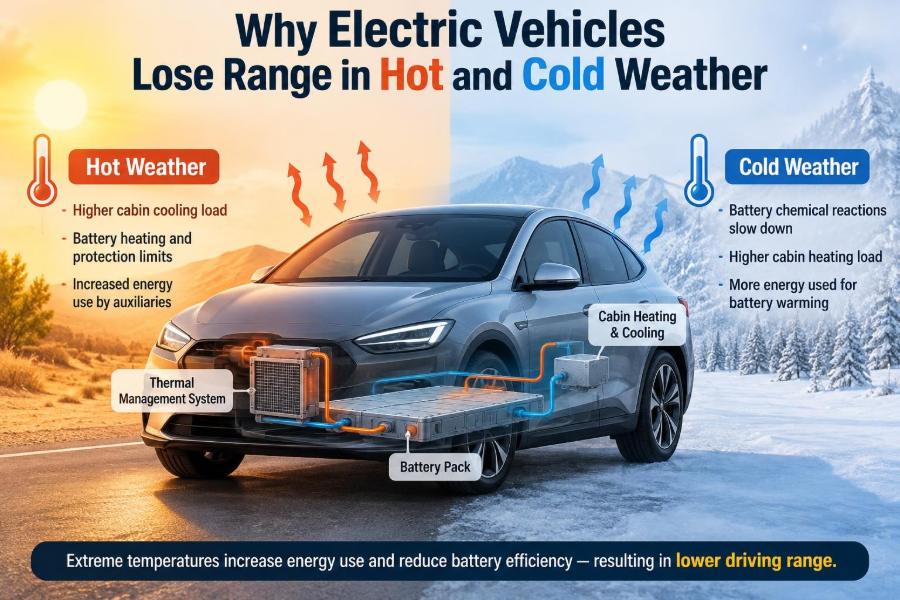
Temperature changes affect both the battery and the systems surrounding it. In winter, an electric vehicle (EV) must warm people, glass, motors, and sometimes the battery itself. In summer, it must remove heat from the cabin and protect the battery from excessive temperature.
This matters because range is more than a laboratory rating. It determines charging stops, route planning, fleet schedules, towing confidence, and whether a driver can arrive with a sensible reserve.
Understanding the mechanisms makes seasonal range changes much less mysterious. It also helps engineers design better thermal systems and helps drivers use their EVs more effectively without treating normal behavior as a failure.
🌡️ Range Is an Operating Result, Not a Fixed Number
An EV’s displayed range is an estimate based on battery energy, recent energy consumption, driving conditions, and vehicle settings. It is not a permanently fixed distance stored inside the battery.
A battery pack may contain the same broad amount of stored energy on two days, yet the vehicle can travel very different distances. More energy may be consumed per kilometre because of heating, cooling, slower battery chemistry, wet roads, wind, or tyre changes.
Range falls whenever the energy needed per kilometre rises or when less of the pack’s energy is practically available. Temperature can influence both at once.
🔋 The Battery Pack Is an Electrochemical System
Most modern EVs use lithium-ion cells. Inside each cell, lithium ions move through an electrolyte between a positive electrode and a negative electrode while electrons travel through the external circuit to power the vehicle.
This movement is governed by electrochemistry, not simply by the amount of charge shown on a display. Temperature changes the speed of chemical reactions and the ease with which ions move through the cell.
Battery engineers therefore care about an operating temperature window. Cells can work outside their preferred range, but performance, charging behavior, and long-term durability may be less favourable.
❄️ Cold Slows Ion Movement Inside Cells
At low temperatures, the electrolyte becomes less able to transport lithium ions efficiently. Chemical reactions at the electrode surfaces also proceed more slowly.
The practical result is higher internal resistance. Think of it as extra restriction within the battery: when the motor requests power, a larger share of energy is lost as heat inside the pack rather than delivered usefully to the wheels.
A cold pack can therefore feel less responsive under high demand, and it may appear to have less usable capacity until it warms. The effect is usually temporary; it is not automatically evidence of permanent battery degradation.
⚡ Voltage Sag Reduces Usable Energy
Every battery has internal resistance. When current flows, the voltage at the battery terminals drops below its resting voltage; this is commonly called voltage sag.
Cold conditions increase resistance, so voltage sag becomes more pronounced during acceleration, hill climbing, or high-speed driving. The battery management system must keep cell voltages within safe limits, which can restrict available power or declare the lower state-of-charge limit earlier.
This explains why a cold battery may offer less usable energy even though its cells still contain energy chemically. Once the pack warms, some of that apparent loss can be recovered.
🧊 Cold Weather Also Limits Regenerative Braking
Regenerative braking turns some vehicle kinetic energy back into electrical energy. During deceleration, the traction motor becomes a generator and sends energy into the battery.
A very cold battery may not accept charge quickly enough to receive strong regenerative braking safely. The vehicle can reduce regeneration until the cells warm or until the state of charge falls from nearly full.
Drivers may notice a different deceleration feel, especially just after starting. This does not mean regeneration has failed; it usually reflects battery-protection logic.
🏠 Cabin Heating Is a Major Winter Load
An internal-combustion vehicle produces abundant waste heat from its engine. An EV’s electric drivetrain is efficient, so it produces much less spare heat for warming the cabin.
Cabin heat must therefore come from electricity. A resistance heater is straightforward and effective, but it converts electrical energy directly into heat and can draw substantial power on a cold day.
Short trips are especially affected. The energy used to heat the cabin and defrost the windows is spread over only a few kilometres, so consumption can look surprisingly high.
🪟 Defrosting Requires More Than Warm Air
Safe winter driving often requires front and rear defrosting, heated mirrors, and sometimes heated washer nozzles. The front defrost mode may also operate the air-conditioning compressor to dry the air and remove windscreen fog.
That combination is deliberate: warm, dry air clears glass more effectively than warm humid air. It also means a vehicle can use meaningful energy even when the cabin temperature setting seems modest.
Visibility systems should not be disabled solely to preserve range. A clear windscreen is a safety requirement, not a luxury feature.
♨️ Heat Pumps Reduce Heating Energy, Within Limits
Many EVs use a heat pump instead of, or alongside, resistance heating. A heat pump moves heat from one place to another, much like a reversible air-conditioning system, rather than producing all heat directly from electricity.
Because it transfers heat, it can often provide several units of cabin heat for one unit of electrical input under suitable conditions. This can materially reduce winter energy use compared with resistance heating.
Its advantage is not unlimited. As outside air becomes colder, less heat is available to extract and the system works harder. Manufacturers may use resistance heating as support in severe conditions or during rapid warm-up.
☀️ Heat Creates a Different Battery Challenge
Warm weather generally improves immediate cell conductivity compared with a cold start, but excessive temperature introduces another set of constraints. High heat accelerates unwanted chemical side reactions inside lithium-ion cells.
Those reactions can contribute to faster ageing over time, particularly when a battery remains hot while highly charged. A well-designed EV therefore uses thermal management to prevent the pack from becoming too hot.
On a hot day, some battery energy is spent actively maintaining safe temperatures. The energy cost may be less obvious than winter cabin heating, but it is real.
💨 Air Conditioning Draws Traction-Battery Energy
Air conditioning uses an electric compressor, fans, pumps, and control hardware. When sunlight has heated the cabin, the system must first remove stored heat from seats, trim, glass, and interior air before it can maintain a comfortable temperature.
The initial cool-down can demand more energy than steady operation. A vehicle parked in direct sun is therefore likely to show a larger early-trip consumption penalty than one parked in shade.
Cooling is usually a smaller range burden than intense cabin heating in very cold conditions, but the actual effect depends on climate, vehicle size, glazing, insulation, and trip length.
🌞 Solar Load Makes Parked Cars Harder to Cool
Solar load is the heat gained from sunlight, especially through the windscreen and side windows. Dark interior surfaces absorb radiant energy and can become much hotter than the surrounding air.
When the driver returns, the climate system must remove that accumulated heat. Opening windows briefly before setting off can help release hot air, although this is only practical where conditions are safe.
Sunshades, shaded parking, and preconditioning while connected to a charger can reduce the first few minutes of heavy cooling demand.
🧠 The Battery Management System Sets Safe Limits
The battery management system, or BMS, monitors cell voltage, current, temperature, and estimated state of charge. It decides how much power the pack can safely deliver and accept at a given moment.
When temperatures are extreme, the BMS may limit acceleration power, regenerative braking, or charging speed. These limits can feel inconvenient, but they protect cells against conditions that could shorten life or create safety risks.
Range estimates also rely on BMS calculations. State of charge cannot be measured by a simple fuel gauge float; it must be estimated from electrical measurements, cell behaviour, and software models.
🧪 Thermal Management Keeps Cells Near Their Comfort Zone
Most current EVs use liquid cooling or heating loops connected to the battery pack. Coolant, pumps, valves, heat exchangers, and sometimes refrigerant circuits move heat where it is needed.
Some simpler designs rely more on air cooling, which can be adequate in certain applications but gives engineers less control during demanding charging, towing, or extreme weather. Pack design, cell chemistry, and expected use all influence the chosen system.
The goal is not to hold every cell at one exact temperature. It is to keep temperatures within acceptable limits and minimise temperature differences across the pack.
🔄 Preconditioning Uses Energy at the Best Time
Preconditioning warms or cools the cabin before departure. Some vehicles also prepare the battery for driving or fast charging.
When the vehicle is plugged in, preconditioning can draw much of this energy from the grid instead of the traction battery. The driver begins with a more comfortable cabin and, in cold weather, potentially a warmer and more efficient pack.
Battery preconditioning should not be confused with cabin preheating. A warm cabin is pleasant, but it does not necessarily mean the battery has reached its preferred temperature.
🔌 Fast Charging Is Temperature Sensitive
Rapid DC charging sends high power directly to the battery pack. Cold cells accept high charging currents poorly, while overly hot cells may also need reduced charging power for protection.
Before arriving at a fast charger in winter, an EV may use energy to warm its battery. This can reduce driving range on the approach, but it may shorten the charging stop by allowing the pack to accept power more readily.
Charging speed depends on many variables: pack temperature, state of charge, charger capability, cell design, and software strategy. A cold-weather charging session should not be judged against a warm-weather peak-rate advertisement.
📉 State of Charge Changes What Drivers See
A battery near full charge has less room to accept regenerative energy, regardless of weather. If it is also cold, the regeneration limit can be more noticeable.
At lower state of charge, the BMS may protect the battery by reducing peak power under heavy demand. Cold weather can make this behaviour appear sooner because voltage sag is greater.
For routine use, following the vehicle manufacturer’s charging guidance is usually more useful than trying to keep the pack at a particular percentage in every season.
🚗 Speed Magnifies Seasonal Range Loss
At higher speeds, aerodynamic drag rises rapidly. The motor must continually supply more power to push air aside, and that demand is added to heating or cooling loads.
Cold dense air can modestly increase aerodynamic resistance. Winter tyres, cold tyre rubber, slush, standing water, and headwinds can further raise energy consumption.
This is why a winter motorway journey can show a larger range reduction than a slower urban trip, even when both experience the same outside temperature.
🛞 Tyres and Road Surfaces Matter Too
Tyre rolling resistance is another part of the seasonal picture. Winter tyres are designed for grip in low temperatures and snow, but their tread pattern and compound can create more rolling resistance than a low-resistance summer tyre.
Wet, snowy, or slushy surfaces also make tyres work harder. Water and slush must be displaced, while repeated wheel slip can waste energy that would otherwise move the vehicle forward.
Correct tyre pressure matters in every season. Pressure falls as air temperature drops, so checking it against the manufacturer’s specified cold pressure is a sensible winter routine.
🌧️ Weather Is More Than the Temperature Reading
Two days at the same thermometer reading can produce different range results. Wind, rain, road contamination, passenger load, elevation change, traffic flow, and parking conditions all alter energy use.
A strong headwind acts much like driving faster because the vehicle experiences a higher relative air speed. Rain can add rolling resistance, while a steep climb consumes energy that may not be fully recovered on the descent.
Temperature is therefore a major driver, but it should not be used as the single explanation for every disappointing trip estimate.
📊 Comparing Cold and Hot Weather Effects
| Condition | Main battery effect | Main vehicle energy load | Likely driver observation |
|---|---|---|---|
| Cold start | Higher internal resistance and reduced charge acceptance | Cabin heat, defrost, battery warming | Higher consumption, limited regeneration |
| Cold high-speed trip | Greater voltage sag under demand | Heating, aerodynamic drag, tyre and road losses | Range falls faster than urban estimate |
| Hot parked vehicle | Pack may need cooling protection | Initial cabin cool-down | High consumption soon after departure |
| Hot long journey | Thermal system manages heat from cells and charging | Air conditioning and cooling pumps | Possible reduction in charging or power if temperatures remain high |
The table shows why “weather range loss” is not one phenomenon. Different systems dominate under different conditions.
🧭 The Dashboard Estimate Learns From Recent Driving
Many vehicles update their predicted range using recent consumption. After several short, cold trips with heavy heating, the estimate may decline; after gentler warm-weather driving, it may rise.
This can look alarming when seasons change, but it is often the estimator adapting to current conditions. It should be treated as a planning aid, not as a promise that every route will match the displayed number.
For longer journeys, route-based energy predictions are often more useful because they can account for distance, speed, elevation, and planned charging stops.
🧍 Short Trips Carry a Disproportionate Penalty
Consider a hypothetical five-kilometre winter commute. The cabin heater, defroster, and battery-conditioning systems may run strongly for much of the journey, leaving little time for those loads to settle.
On a 100-kilometre trip, the same initial warm-up energy is spread across far more distance. Consumption may still be higher than in mild weather, but the penalty per kilometre is often smaller.
Drivers who mainly make short journeys should expect seasonal efficiency figures to vary more dramatically than drivers who regularly travel longer distances.
🚚 Towing and Heavy Loads Add Thermal Demand
Towing, carrying heavy cargo, climbing grades, and sustained high speeds all require more traction power. More power means more heat generated in motors, inverters, cables, and battery cells.
In cold weather, the pack may be fighting both low-temperature resistance and high load. In hot weather, the cooling system may need to remove substantial heat for long periods.
Range planning for towing should be conservative in any season, and even more so in temperature extremes. Trailer shape can also greatly increase aerodynamic drag.
🛠️ Practical Winter Habits That Help
The aim is not to endure an uncomfortable cabin or drive unsafely. It is to direct energy use intelligently and avoid preventable losses.
- Precondition the cabin while the vehicle is connected to power when practical.
- Use seat and steering-wheel heaters; they warm occupants directly and may allow a slightly lower cabin setting.
- Clear snow and ice from the vehicle so visibility and aerodynamics are not compromised.
- Check tyre pressures when temperatures fall.
- Expect reduced regeneration after a cold start and leave extra following distance.
- Plan charging with a buffer, especially before fast-charging stops in very cold weather.
These measures reduce waste, but they do not remove the underlying electrochemical effect of cold on the battery.
🧊 Practical Hot-Weather Habits That Help
Heat management starts before the drive. Parking in shade, using a reflective sunshade, and ventilating a hot cabin briefly can lower the initial cooling burden.
When plugged in, scheduled pre-cooling can make the cabin comfortable before departure while preserving more driving energy. During very hot periods, avoiding long parking times at a high state of charge may be sensible where it aligns with the manufacturer’s guidance.
- Use recirculation after the cabin has cooled, when appropriate for visibility and occupant comfort.
- Choose shaded parking where available.
- Do not block cooling intakes or ignore thermal-system warnings.
- Allow extra time at rapid chargers if the vehicle has been working hard in heat.
Comfortable cooling is a legitimate use of the vehicle. The practical goal is efficiency, not unnecessary discomfort.
⚠️ Common Misinterpretations to Avoid
A seasonal drop in range does not automatically mean the battery is damaged. Temporary cold-related limits and permanent capacity loss are different phenomena.
It is also misleading to compare a short, heated winter commute with an official laboratory range figure. Laboratory tests are standardized for comparison, while real journeys include weather, speed, terrain, accessories, and driver choices.
Finally, turning off demisting to save energy is a poor trade-off. Safe visibility and stable vehicle control take priority over a small range improvement.
🔧 What Engineers Can Improve
Vehicle engineers can reduce seasonal range variation through better cell chemistry, improved electrode design, accurate battery-state estimation, efficient heat pumps, stronger insulation, and integrated thermal loops.
Software also matters. Predictive control can prepare a battery before a scheduled fast charge, manage coolant flow efficiently, and tailor climate operation to occupancy rather than conditioning every seat equally.
There are trade-offs. More thermal hardware can improve performance but adds cost, mass, complexity, and potential service requirements. The best design depends on the vehicle’s intended climate, price, size, and duty cycle.
🔬 Cell Chemistry Influences Cold and Heat Behaviour
Not all lithium-ion batteries use identical electrode materials. Different chemistries can have different energy density, power capability, cost, cold-temperature behaviour, and thermal characteristics.
This is one reason two EVs with similar battery sizes can behave differently in winter or during repeated rapid charging. Pack design and thermal control can be as influential as the chemistry label alone.
Public comparisons should therefore focus on the complete vehicle and its expected use, rather than assuming one battery type is universally superior.
🏙️ Fleet and Workplace Charging Can Reduce Disruption
For delivery fleets, taxis, and commuting workforces, seasonal range variation affects scheduling and charger availability. Vehicles that leave with cold packs and cold cabins may consume more energy during their first duty cycle.
Covered parking, timed preconditioning, dependable overnight charging, and route allocation based on expected weather can make operations more predictable. These are operational choices, not just vehicle features.
Fleet managers should also distinguish normal temperature effects from unusual energy consumption that might indicate tyre, brake, HVAC, or battery-system problems.
🧾 When a Range Drop Deserves Inspection
Normal seasonal variation tends to track weather and usage. If range falls sharply in mild conditions, warning messages appear, cabin heating or cooling performs poorly, or charging behavior changes unexpectedly, the vehicle should be assessed according to the manufacturer’s service process.
Other causes can mimic a battery problem: underinflated tyres, dragging brakes, damaged underbody panels, an HVAC fault, poor wheel alignment, or an inaccurate consumption assumption after a change in driving pattern.
Diagnostic data is more meaningful than a single dashboard estimate. A qualified technician can examine fault codes, pack temperatures, charging behaviour, and usable capacity where the vehicle supports that assessment.
🧩 The Core Principle: Manage Energy and Temperature Together
Weather reduces EV range through a combination of battery physics and auxiliary loads. Cold slows electrochemical processes and increases the energy needed for warmth and clear windows; heat requires cabin cooling and battery protection.
Speed, route, tyres, wind, road condition, trip length, and charging strategy determine how visible those effects become. No single percentage describes every EV, every climate, or every journey.
The most useful approach is to treat range as a temperature-sensitive energy budget: prepare the vehicle when connected, plan with a reserve, and let the thermal and battery-management systems protect the pack.
Electric vehicles do lose range in hot and cold weather, but the change is understandable, manageable, and often temporary rather than a sign of failure. Better planning and realistic expectations turn seasonal range from a surprise into another predictable part of driving. 🔋❄️☀️