
A driver buys a car with a familiar assumption: most of what it can do is fixed on the day it leaves the dealership. The engine, brakes, lighting, dashboard, and safety systems may be sophisticated, but their basic behavior seems permanent.
Then an update arrives. The navigation interface changes, a battery-management feature improves, or a driver-assistance function is added to a subscription menu. Suddenly, the car feels less like a finished mechanical product and more like a connected computing platform.
That shift is changing the way vehicles are designed, built, repaired, regulated, and owned. It also explains why many carmakers are reorganizing engineering teams and electronics architectures rather than simply adding bigger screens.
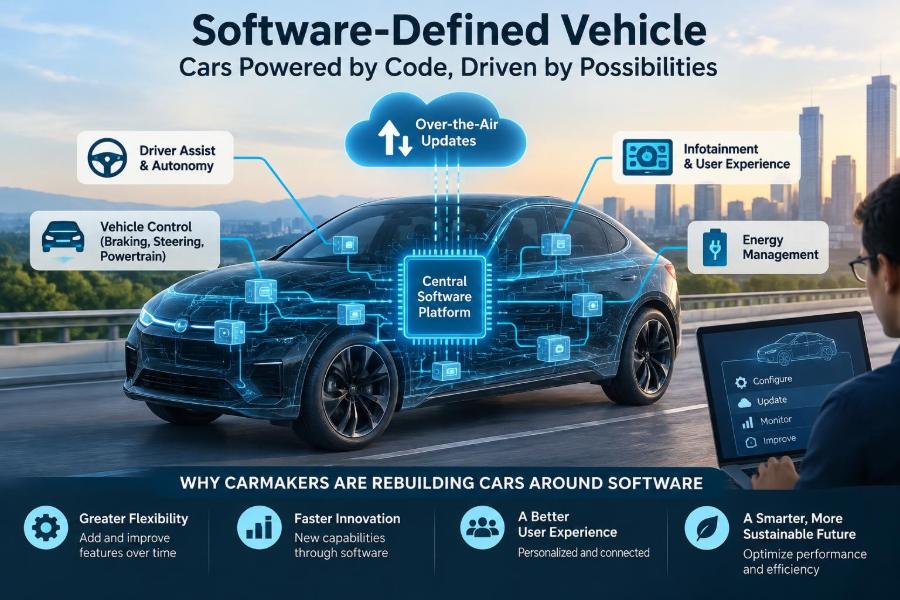
A software-defined vehicle, often shortened to SDV, is not just a car with apps. It is a vehicle whose functions can be developed, changed, coordinated, and improved substantially through software during its life.
🚘 The Simple Definition of a Software-Defined Vehicle
In a conventional vehicle, hardware largely determines capability. A control unit is installed for a specific job, its software is closely tied to that job, and major changes often require replacing components or visiting a workshop.
In an SDV, software becomes a central way of defining vehicle behavior. Computing resources, sensors, networks, and actuators are designed so that functions can be updated or introduced after production, within engineering and safety limits.
This does not mean the physical car becomes unimportant. Tires still grip the road, batteries still age, and brakes still require robust mechanical design. The difference is that software increasingly decides how physical systems work together.
🧠 Software Has Been in Cars for Decades
The phrase can sound new, but automobiles have used embedded software for many years. Engine control units manage fuel injection and ignition timing; anti-lock braking systems react to wheel speed; airbags use electronic sensors and decision logic.
What is changing is the scale and organization of software. Modern vehicles may contain many electronic control units, or ECUs, communicating across several networks. Features now span infotainment, energy management, body controls, diagnostics, security, and automated-driving assistance.
An SDV approach tries to make this software estate less fragmented. Rather than treating every ECU as an isolated product, manufacturers aim to create a coordinated vehicle platform.
🔧 Why the Traditional ECU Model Reached Its Limits
Historically, suppliers delivered dedicated modules for dedicated functions: one for seats, another for windows, another for power steering, and so on. This worked well when functions were relatively independent and vehicles changed slowly.
Problems arise when a feature needs information from many domains. For example, an energy-efficient route suggestion may need battery state, charging data, navigation, thermal-system status, and driver preferences. Joining isolated modules can create complicated interfaces and duplicated data.
More ECUs also mean more wiring, more software versions to validate, and more potential communication faults. The industry is therefore moving toward fewer, more capable computers.
🏗️ From Distributed Modules to Vehicle Computing Platforms
A modern SDV architecture commonly uses high-performance computers that run several functions, supported by smaller controllers near sensors and actuators. These central computers have more processing power and can be updated more systematically.
This is often called a shift from an ECU-centric design to a compute-centric design. The goal is not to put every control loop in one box. Safety-critical and time-sensitive functions may still need local processing.
The practical aim is sensible distribution: fast local action where needed, shared computing where it adds flexibility, and clearly defined communication between them.
🗺️ Domain, Zonal, and Central Architectures
Automotive electronics are commonly described through three architecture patterns. A domain architecture groups systems by function, such as powertrain, body, infotainment, or driver assistance. It reduces some duplication but can still require many controllers and long wiring runs.
A zonal architecture groups hardware by physical location in the car. A zone controller near the front-left area, for instance, can serve nearby lights, sensors, and actuators, then connect to central computers through a high-speed network.
| Architecture | Main organizing idea | Typical advantage | Main challenge |
|---|---|---|---|
| Distributed ECU | One controller per function | Clear local responsibility | Complex integration |
| Domain | Controllers grouped by system | Better functional coordination | Cross-domain features remain difficult |
| Zonal | Controllers grouped by location | Less wiring and scalable hardware | Requires mature network design |
| Central compute | Powerful shared computers | Flexible software deployment | High safety and availability demands |
🌐 The Vehicle Network Becomes a Backbone
Software-defined functions depend on data moving reliably around the vehicle. Older networks such as CAN remain valuable for many control tasks, while automotive Ethernet is increasingly used where higher bandwidth is needed.
Cameras, radar, displays, central computers, and diagnostic tools may exchange far more data than a simple switch signal. Network design must therefore consider bandwidth, latency, synchronization, fault isolation, and cybersecurity.
Think of wiring as both the vehicle’s nerves and roads. A powerful computer cannot deliver a good function if essential information arrives late, corrupted, or through an insecure route.
🧩 Hardware Abstraction Makes Change Possible
One reason software updates are difficult in older vehicles is that applications may be written directly for a specific chip, controller, and input-output layout. Reusing that code on a new hardware generation can require major rework.
Hardware abstraction adds a controlled layer between an application and the physical hardware. The application asks for a service—such as wheel-speed data—rather than needing to know every electrical detail of the sensor connection.
This approach does not remove engineering complexity. It makes interfaces explicit, supports reuse, and helps software teams develop functions without constantly changing low-level code.
💻 Operating Systems and Middleware in the Car
Many vehicle computers need an operating system to schedule tasks, manage memory, control access to hardware, and support communications. The choice may differ by use case: a safety controller has different needs from an infotainment computer.
Middleware sits between applications and lower-level software. It can provide common services for messaging, data storage, diagnostics, logging, and service discovery. In effect, it gives separate applications a shared way to cooperate.
Standardized platforms can reduce repeated effort, but standards alone do not create a good vehicle. Carmakers still need disciplined system architecture and careful integration.
⚙️ What Software Actually Controls
SDV software reaches far beyond the center display. It can influence how energy is used, how cabin comfort is managed, how displays present information, how doors respond, and how diagnostic data is collected.
- Battery charging schedules and thermal management strategies
- Drive-mode behavior, including throttle response and regenerative braking feel
- Lighting, climate control, seat settings, and access functions
- Navigation, media, voice interaction, and phone integration
- Driver-assistance features, warnings, and sensor calibration workflows
Not every function should be freely adjustable. Braking and steering controls, for example, are governed by strict safety engineering and validation requirements.
🔄 Over-the-Air Updates Change the Ownership Model
An over-the-air, or OTA, update delivers software to a vehicle through a wireless connection. It may update an infotainment application, refine a control strategy, fix a defect, or add a compatible feature.
For owners, OTA updates can reduce workshop visits and keep systems current. For manufacturers, they allow faster correction of certain software issues and provide a route to improve a fleet after sale.
But an OTA update is not automatically safe or useful. The vehicle must verify the update’s authenticity, preserve a recoverable version, manage power conditions, and avoid interrupting critical operation.
🛡️ Secure Updates Require More Than Encryption
Encryption helps protect software in transit, but secure updating is a broader process. The car must confirm who signed the package, whether it is intended for that vehicle, and whether its version is acceptable.
Secure boot is also relevant: at startup, the system checks that trusted software is running. A protected hardware component can store cryptographic keys and help prevent unauthorized code from being accepted.
A robust update design includes staged deployment, error reporting, rollback planning, and clear recovery procedures. Updating a car is closer to maintaining safety-related infrastructure than refreshing a phone app.
🔒 Cybersecurity Is Now a Vehicle Engineering Discipline
Connectivity creates useful services, but every wireless interface, diagnostic port, cloud service, and supplier connection can create an attack path. Cybersecurity must be designed into the vehicle, not attached at the end of development.
Engineers use threat analysis to ask practical questions: What asset needs protection? Who might attack it? How could they enter? What would happen if a message were altered or a controller became unavailable?
Defenses can include network segmentation, authenticated messages, least-privilege access, intrusion monitoring, secure diagnostics, and incident-response processes. No single measure is enough.
🛑 Functional Safety Does Not Equal Cybersecurity
Functional safety concerns hazards caused by malfunctioning behavior, such as a sensor fault leading to an unsafe control action. Cybersecurity concerns intentional attempts to compromise systems or data.
They overlap because a cyberattack can create a safety hazard. Yet they use different methods, assumptions, and evidence. A component can be functionally safe in normal fault conditions but still be vulnerable to unauthorized access.
SDV development must consider both from the start, alongside reliability, privacy, and regulatory compliance.
🚦 Real-Time Performance Still Matters
Some automotive tasks can tolerate a brief delay; updating album artwork cannot endanger the vehicle. Other tasks, such as coordinating a braking or steering response, may have strict timing requirements.
This is why “centralized” does not mean every decision travels to a distant computer or cloud server. Time-critical control often stays close to the actuator, while central software supervises, coordinates, or provides higher-level strategies.
Engineers must define latency budgets, fallback behavior, and what happens when data is unavailable. A feature is only as dependable as its worst credible operating condition.
☁️ The Cloud Extends the Vehicle but Does Not Drive It
Cloud systems can support fleet monitoring, map delivery, remote services, customer accounts, and software-release management. They are useful for analyzing aggregated data and operating connected services at scale.
However, a road vehicle cannot rely on a continuous network connection for basic safe operation. Coverage varies, services can fail, and communications introduce delay.
A sound design separates cloud-enhanced convenience from essential vehicle control. The car must retain safe local behavior when disconnected.
📡 Sensors Turn Physical Events into Data
Software can only make decisions from the information it receives. Cameras, radar, ultrasonic sensors, inertial sensors, wheel-speed sensors, temperature sensors, and position sensors each provide different views of the vehicle and surroundings.
Sensor data may be noisy, delayed, blocked, or misleading in difficult conditions. A camera may struggle with glare; radar has different strengths and limitations; a wheel-speed sensor cannot directly identify road surface grip.
Sensor fusion combines inputs to form a more useful estimate. It improves robustness in some cases, but it does not make uncertainty disappear.
🤖 Driver Assistance Shows Both the Promise and the Limits
Advanced driver-assistance systems, or ADAS, are prominent SDV applications because they require sensors, computing, user interfaces, and continual software refinement. Examples include lane-support functions, adaptive cruise control, and collision warnings.
These systems must be described accurately. Their operational limits depend on sensor conditions, road markings, weather, system design, and the specific feature. A driver-assistance system is not automatically a self-driving system.
Clear driver information matters as much as advanced algorithms. If users misunderstand a feature’s capability, convenience can become a safety risk.
🔋 Electric Vehicles Make Software More Visible
Electric vehicles rely heavily on software to coordinate battery cells, power electronics, motors, charging, and thermal systems. The battery-management system estimates state of charge and helps keep cell operation within appropriate limits.
Software can optimize cabin heating, route planning, regenerative braking, and charging preparation. These choices can affect range, comfort, component life, and charging performance.
Still, software cannot repeal physics. Cold weather, towing, high speed, terrain, and battery condition influence energy use, regardless of interface design or update frequency.
🎛️ Vehicle Features Become Digital Products
When functions are software-controlled, manufacturers can offer different configurations through the same underlying hardware. A customer might enable a navigation package, a lighting animation, or a comfort feature where the hardware and approvals already support it.
This flexibility can simplify manufacturing and let owners add compatible capabilities later. It can also create frustration if hardware already installed in a vehicle is locked behind recurring fees.
The fair question is not whether a feature is digital. It is whether pricing, ownership terms, privacy practices, and continuing support are clear and reasonable.
📱 User Experience Is Part of Vehicle Safety
Large displays and voice systems can reduce clutter, but they can also move simple actions into menus. If a driver must search through screens to change a frequently used setting, the interface may increase distraction.
Good automotive user experience considers glance time, tactile feedback, readability in sunlight, physical accessibility, and failure modes. Certain frequently used controls may still benefit from dedicated buttons or switches.
A software-defined cockpit should not mean a screen-defined distraction. The interface has to serve driving first.
🏭 Carmakers Are Changing How They Develop Vehicles
Traditional vehicle programs often follow long hardware-led development cycles. SDVs require more continuous software work: feature planning, code integration, automated testing, release management, monitoring, and maintenance after launch.
This encourages practices associated with software engineering, such as version control, continuous integration, automated regression testing, and cross-functional teams. Automotive validation remains more demanding than many consumer software releases because failures can affect physical safety.
The organizational shift is substantial. Mechanical, electrical, software, cybersecurity, manufacturing, service, and legal teams need earlier and closer coordination.
🧪 Validation Must Cover the Whole System
Testing one controller in isolation is not enough when a feature depends on networks, sensors, displays, cloud services, and other controllers. Engineers use simulation, hardware-in-the-loop testing, vehicle prototypes, track testing, and road testing for different questions.
A hardware-in-the-loop setup connects a real controller to simulated vehicle inputs and outputs. It lets teams test unusual or risky scenarios repeatedly without placing a development vehicle in that condition.
Validation also continues after release. Field reports can reveal rare interactions that were difficult to reproduce before production, although fixes still require disciplined assessment.
🩺 Diagnostics and Repair Will Evolve
Software-defined vehicles can provide richer diagnostic information, including fault logs, sensor status, and health data. This may help technicians identify intermittent faults faster than with basic warning codes alone.
At the same time, repair becomes more dependent on diagnostic tools, software access, calibration procedures, and cybersecurity permissions. Replacing a physical part may require configuration or pairing it securely with the vehicle.
Independent repairers, vocational programs, and dealerships will need training that combines electrical measurement, network diagnostics, and software-aware service procedures.
🔩 Hardware Still Determines the Boundaries
A common mistake is to assume that software can improve anything indefinitely. Software may refine a motor-control strategy, but it cannot give an undersized cooling system unlimited heat rejection or make worn tires grip like new ones.
Similarly, a camera-based feature may improve through better algorithms, but it cannot see through every obstruction. Computing capacity, sensors, actuators, electrical power, and mechanical durability set real limits.
The strongest SDVs are designed with enough hardware margin and sensor capability for their intended lifecycle, rather than relying on vague promises of future upgrades.
⚠️ Complexity Creates New Failure Modes
Consolidating functions can reduce module count, yet it can increase the consequence of a failure in a shared computer or network. Engineers address this with redundancy, isolation, degraded modes, watchdog functions, and careful power architecture.
A degraded mode is a planned reduced-function state. For example, if a nonessential service fails, the vehicle should preserve core driving and safety functions rather than becoming unusable.
Complexity also affects ownership. Long-term software support, server availability, compatibility with replacement parts, and update policies can influence whether a vehicle remains practical years later.
📜 Regulation and Standards Shape the Design
Vehicle software operates within a growing set of safety, cybersecurity, privacy, emissions, consumer-protection, and type-approval requirements. The exact obligations vary by market and vehicle category.
International and industry standards provide frameworks for areas such as functional safety, cybersecurity engineering, and software processes. They do not remove the need for engineering judgment; they help teams document risks, requirements, verification, and responsibility.
For engineers, compliance should not be treated as paperwork added after design. Traceability—from a requirement to code, test evidence, and release decision—is central to responsible development.
🧑🔧 Skills Automobile Engineers Need Now
Mechanical fundamentals remain essential, but modern automobile engineering increasingly rewards systems thinking. Engineers need to understand how physical behavior, electronics, software, communications, and human factors influence one another.
- Basic embedded programming and software architecture
- Vehicle networks, diagnostics, and data communication
- Control systems, sensors, and actuator behavior
- Functional safety, cybersecurity, and requirements engineering
- Testing methods, data analysis, and configuration management
No individual needs to master every specialty. The valuable skill is being able to communicate across disciplines and recognize where an interface can create risk.
🎓 A Practical Learning Path for Students
Start with vehicle fundamentals: powertrain operation, braking, steering, electrical systems, and dynamics. Software knowledge becomes more meaningful when you understand the physical system being controlled.
Then build small projects. A microcontroller reading a sensor and controlling a motor can teach timing, noise, fault handling, and debugging. A CAN-based training setup can introduce messages, identifiers, diagnostics, and network behavior.
Learn to write clear requirements before writing code. For example, “activate a fan when temperature is high” is vague; a useful requirement defines the input, threshold logic, timing, fault response, and intended operating conditions.
🔍 Questions Buyers and Owners Should Ask
Consumers do not need to inspect source code, but they can ask practical questions before choosing a highly connected vehicle. What updates are expected, how are they delivered, and will essential features work without a paid service?
It is also reasonable to ask what data is collected, how consent is managed, whether repair information is available, and what happens if a connected service ends. Answers may differ by market and model.
A feature list alone is not enough. The quality of support, transparency, and failure recovery may matter more over the vehicle’s full life.
🧭 The Core Principle: Software Must Serve the Vehicle
The SDV is best understood as a change in architecture and lifecycle, not a promise that every car should behave like a smartphone. Software can coordinate complex systems, enable improvement after sale, and create more adaptable vehicles.
Its value depends on disciplined engineering: reliable hardware, secure networks, clear driver communication, rigorous testing, repairability, and support that lasts beyond the first owner.
The goal is not to turn cars into gadgets; it is to use software to make vehicles safer, more capable, easier to maintain, and more adaptable without compromising trust.
As cars become more programmable, the most successful designs will be those in which software respects the realities of roads, machines, drivers, and long-term ownership. 🚗💻🛠️