
You press the accelerator to merge onto a fast-moving highway. What you feel first is the car’s willingness to move: does it pull cleanly from low speed, or does it need a downshift and more revs before it responds?
Later, on an open road, the same vehicle may feel very different. It might keep accelerating strongly at higher speed, or its surge may fade even though the engine is still turning quickly. These two sensations point toward torque and horsepower.
They are often treated as rival specifications, especially in advertisements and online discussions. But a vehicle does not need one instead of the other. It needs the right combination, delivered across the useful engine-speed range and multiplied appropriately by the drivetrain.
Understanding the distinction helps students read performance data more accurately and helps drivers make sense of towing, hill climbing, gear selection, fuel use, and the character of different powertrains.
🧭 The Simple Starting Point
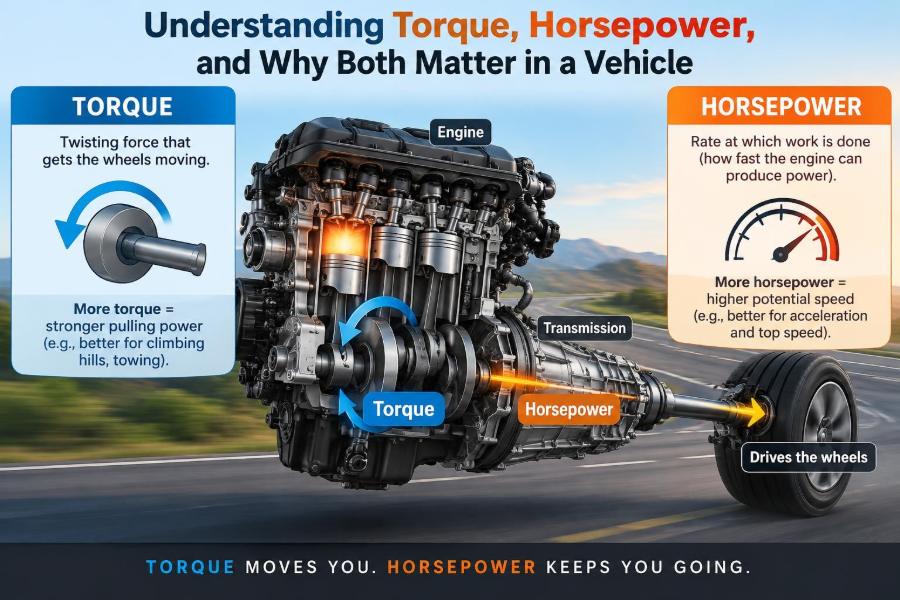
Torque is a twisting force. In an engine, combustion pushes pistons, the connecting rods act on the crankshaft, and the crankshaft experiences torque. It is commonly expressed in newton-metres (N·m) or pound-feet (lb-ft).
Power, commonly called horsepower in vehicle discussions, is the rate at which work is done. It combines torque with rotational speed. A motor can produce a large twisting force, but if it turns slowly, it may still produce modest power.
A useful first picture is this: torque is the twist available at an instant; power describes how quickly that twist can keep doing useful work.
🔩 Torque Is a Turning Force
Imagine loosening a tight wheel nut with a wrench. Pushing harder creates more force, while using a longer wrench gives that force a larger lever arm. Both increase torque at the nut.
In engineering terms, torque is force multiplied by perpendicular distance from the axis of rotation. A crankshaft is simply a rotating lever system, with the combustion force acting through the crank geometry.
Torque by itself does not state how fast the crankshaft is rotating. That missing speed element is why torque alone cannot fully describe acceleration at every road speed.
⚡ Horsepower Measures the Rate of Work
Power answers a different question: how rapidly can energy be transferred? Raising a load up a hill slowly requires work. Raising the same load through the same height in half the time requires twice the power.
Mechanical power is often stated in kilowatts (kW) in technical specifications. Horsepower is another unit; its exact conversion varies slightly with the horsepower convention used, so technical documents should identify the unit where precision matters.
For everyday comparison, horsepower and kilowatts describe the engine’s capacity to sustain work at a given rate. This becomes especially relevant when speed, aerodynamic drag, or a long climb demands continuous output.
🧮 The Equation That Connects Them
The relationship is straightforward: power equals torque multiplied by angular speed. In SI units, power in watts equals torque in N·m times angular speed in radians per second.
When engine speed is given in revolutions per minute, the same relationship is often written as: P(kW) = T(N·m) × rpm / 9550. The constant handles the unit conversions.
This means power can rise even when torque is falling, provided engine speed rises enough. It also means a high-revving engine can make considerable power without having the largest peak torque figure.
📈 Why Torque and Power Curves Matter More Than Peaks
A brochure’s largest torque and power numbers are only two points on much larger curves. The engine does not operate only at the rpm where its peak occurs.
A broad, flat torque curve can make a car feel responsive during ordinary driving because useful torque is available over many engine speeds. A narrow peak may be impressive on paper but require careful gear selection to access.
Likewise, the area and shape of the power curve affect how strongly a vehicle can continue accelerating as road speed increases. Always ask where the engine produces its output, not merely how much at its best moment.
🚙 What Actually Pushes the Vehicle Forward
The tyre contact patches push backward on the road, and the road pushes the vehicle forward. The force available there is called tractive force.
Engine torque reaches the driven wheels through the clutch or torque converter, transmission, final-drive gears, differential, driveshafts, and axles. Gear reduction can multiply torque substantially before it reaches the wheels.
Therefore, engine torque is not identical to wheel torque. A modest-torque engine in a low gear can generate more wheel torque than a larger engine operating in a tall gear.
⚙️ Gear Ratios Multiply Torque
In an idealised gearbox, a 3:1 reduction means the output shaft turns once for every three input turns. Ignoring losses, its output torque is roughly three times the input torque.
That multiplication is why first gear is so useful for moving away from rest, climbing steep gradients, or pulling a load. The trade-off is output speed: the wheels turn fewer times per engine revolution.
Transmission and differential losses reduce the torque that finally arrives at the wheels. Still, the central principle remains: gearing trades rotational speed for torque.
🛞 Tyre Radius Converts Wheel Torque to Force
Wheel torque becomes force at the road through the effective rolling radius of the tyre. For a given wheel torque, a smaller effective radius produces a greater force at the contact patch.
This is one reason tyre size can alter acceleration feel, crawling ability, and speedometer accuracy. Larger-diameter tyres effectively make the overall gearing taller, reducing wheel force in every gear.
The practical result is that an engine specification cannot predict vehicle response without considering transmission ratios, final drive, tyres, mass, and available grip.
🏁 Low-Speed Acceleration Depends on Wheel Force
At low road speeds, aerodynamic drag is comparatively small. If tyres can maintain traction, acceleration depends largely on net force at the wheels after rolling resistance, gradient, and drivetrain losses are considered.
A lower gear raises engine rpm and multiplies engine torque, often producing much stronger acceleration. This is why a manual driver downshifts before overtaking and why an automatic transmission downshifts under a firm accelerator request.
At this stage, “more torque” is meaningful only if it refers to the torque available at the relevant rpm and through the selected gear.
🌬️ High-Speed Performance Depends Heavily on Power
As speed rises, aerodynamic drag rises rapidly, approximately with the square of vehicle speed. The power required to overcome that drag rises even faster because power is force times speed.
Near a vehicle’s maximum speed, the engine’s available wheel power must balance aerodynamic drag, rolling resistance, and drivetrain losses. This is why peak power is closely associated with top-speed capability.
Gearing still matters, but no gearbox can create extra power. It can multiply torque while reducing output speed; it cannot defeat the energy balance at high road speed.
🧗 Hill Climbing Requires Continuous Output
Climbing adds a force equal to the vehicle’s weight component along the slope. A steep grade at low speed may require high wheel torque, so a low gear is essential.
Holding a chosen speed up a long grade requires sufficient power. If road speed falls, a lower gear can return the engine to a higher-power rpm range, but only within the engine’s available output.
This distinction explains why trucks use many closely spaced ratios. They need both high wheel torque to start and enough usable power across a wide range of road speeds.
🚚 Towing Is Not Decided by Peak Torque Alone
High low-rpm torque can make pulling away with a trailer feel easy and can reduce the need for frequent downshifts. It is genuinely useful, particularly in heavy-duty applications.
However, safe and capable towing also depends on cooling capacity, transmission design, brake performance, chassis ratings, hitch limits, axle loads, stability, tyres, and legal requirements. A torque figure is not a tow rating.
On a long uphill route, sustained power and thermal management matter as much as initial pulling force. Consult the manufacturer’s approved towing guidance rather than inferring capability from an engine badge.
🔄 Engine Speed Changes Everything
An engine is not a constant-torque machine. Cylinder filling, combustion timing, friction, intake and exhaust flow, and control strategy all change with rpm.
At very low rpm, an internal-combustion engine may produce limited torque and can stall if loaded too heavily. At high rpm, airflow restrictions and friction often limit further torque production.
The useful operating range between those limits is the engine’s power band. Transmission ratios exist largely to keep the engine near a productive part of that range.
🔥 Naturally Aspirated Engines Build Output with Revs
A naturally aspirated engine draws air using the pressure difference created during intake. Its torque often builds through the mid-range and may decline near redline as breathing becomes less effective.
Because power combines torque and rpm, such engines can produce their strongest power near higher engine speeds. Drivers may need to use more revs and select lower gears for rapid acceleration.
This does not make them weak. It gives them a different response character: progressive output, often with a clear incentive to keep the engine in its upper operating range when performance is needed.
🌀 Turbocharging Can Broaden Low-Rpm Torque
A turbocharger uses exhaust-gas energy to drive a compressor that increases intake-air density. More oxygen allows more fuel to be burned appropriately, increasing potential torque.
Many turbocharged engines deliver a broad plateau of torque at relatively low rpm. This can make a smaller engine feel strong in ordinary acceleration and can support taller gearing.
Response is not identical in every design. Turbo size, boost control, turbine inertia, intake layout, and calibration influence how quickly torque arrives. “Turbo lag” describes a delayed response, not an unavoidable property of every turbocharged engine.
⚡ Electric Motors Deliver Torque Differently
Electric traction motors can produce high torque from zero or very low rotational speed because their electromagnetic torque does not rely on combustion cycles or intake airflow. This gives many electric vehicles immediate launch response.
As motor speed increases, voltage and current limits eventually constrain torque. The system may transition into a region where power is approximately constant and torque decreases with speed.
That is why electric vehicles still have torque and power curves, even when the driver experiences smooth, single-speed acceleration. Battery temperature, state of charge, inverter limits, and motor cooling can affect repeatable performance.
🔋 Battery Power Is Part of EV Performance
An EV motor’s rated capability is only one part of the system. The battery and inverter must supply electrical power, while the cooling system must manage heat generated in the cells, cables, inverter, and motor.
A battery may be able to deliver strong output for a short acceleration but reduce available power when cold, very low in charge, or thermally constrained. This is protective system behaviour, not necessarily a motor limitation.
For EV comparison, look beyond a single torque figure. Vehicle mass, usable power over speed, thermal behaviour, traction control, and repeatability all shape real performance.
🛢️ Diesel and Petrol Engines Have Different Characters
Diesel engines commonly operate at lower maximum rpm than petrol engines and often produce substantial torque at low engine speeds. This suits load-carrying, towing, and relaxed cruising when geared appropriately.
Petrol engines can often operate at higher rpm, allowing them to make competitive or greater power even if their peak torque is lower. Turbocharged petrol engines blur the traditional distinction further.
Neither fuel type is automatically superior. The better match depends on duty cycle, emissions equipment, fuel availability, vehicle mass, driving pattern, cost, and the required balance of low-speed pull and high-speed power.
🧠 Transmission Choice Shapes the Driving Feel
A manual gearbox lets the driver choose rpm directly, making the connection between gear selection and engine output easy to feel. The driver can downshift before a hill or hold a lower gear through a corner.
Traditional automatics, dual-clutch transmissions, and continuously variable transmissions use different methods to select or vary ratios. Their calibration can make the same engine feel eager, smooth, or reluctant.
A transmission that keeps an engine near peak power can improve acceleration. One that selects a taller ratio may improve quietness and fuel economy but can require a kickdown event before rapid acceleration.
📊 Reading a Specification Sheet Correctly
Specifications are most useful when read as a system rather than as isolated headline numbers. Compare vehicles tested under the same rating convention where possible, and note whether a figure is gross, net, crankshaft, or wheel output.
| Specification | What it can suggest | What it cannot tell you alone |
|---|---|---|
| Peak torque | Potential twisting force at a stated rpm | Wheel force, gearing, response, or towing approval |
| Peak power | Potential sustained performance at higher speed | Low-rpm response or traction |
| Torque/power rpm | Where the peak occurs | How broad the useful curve is |
| Kerb mass | One major influence on acceleration and braking | Aerodynamics, tyres, or calibration |
Acceleration tests can be helpful but are also affected by launch method, surface, tyre condition, weather, payload, and state of charge in electrified vehicles.
⚖️ Power-to-Weight Adds Essential Context
Two vehicles with the same peak power can perform very differently if one carries far more mass. Power-to-weight ratio gives a useful first indication of acceleration potential and grade-climbing performance.
It is still not a complete answer. A light vehicle with poor traction may struggle to use its output at launch, while a heavier vehicle with strong low-speed gearing can feel surprisingly capable around town.
For real-world assessment, combine power-to-weight with torque curves, gear ratios, tyre grip, and the speed range that matters for the intended use.
🛑 Traction Can Be the Real Limit
Applying more wheel torque does not guarantee more acceleration. If the contact patches cannot transmit the required force, the tyres slip and some available energy becomes heat and tyre wear.
Road surface, tyre compound, temperature, load transfer, drive layout, differential behaviour, and traction-control calibration all influence the limit. On a wet surface, this limit can arrive far earlier than the engine’s capability.
All-wheel drive can improve the ability to launch by sharing driving force among more contact patches, but it adds mass and complexity and does not eliminate braking or cornering limits.
🧪 Dynamometer Numbers Need Careful Interpretation
An engine dynamometer measures output at the crankshaft under controlled conditions. A chassis dynamometer measures output through the drivetrain at the driven wheels, with methods that vary by machine and test setup.
Wheel figures are lower than crankshaft figures because drivetrains have losses, but a simple fixed “drivetrain loss percentage” is not reliable for every vehicle or operating condition.
Dyno charts are especially valuable for seeing changes before and after a modification when the same vehicle, equipment, correction approach, and conditions are used. Comparing unrelated charts demands caution.
🛠️ Modifications Change More Than a Peak Number
Engine calibration, intake and exhaust changes, forced-induction upgrades, and other modifications may alter torque delivery. A large low-rpm torque increase can overload a clutch, transmission, driveshaft, differential, or tyres if those parts were not designed for it.
More power also increases heat rejection demands. Fuel quality, cooling, lubrication, knock control, emissions compliance, durability, and insurance or warranty implications require serious consideration.
The sound engineering goal is not the highest possible dyno peak. It is a balanced system with safe margins and output that the vehicle can repeatedly use.
🚫 Common Misunderstandings to Avoid
- “Torque accelerates; horsepower only gives top speed.” Wheel force drives acceleration, while power becomes decisive as speed rises. Both are involved.
- “A higher torque number always means a quicker car.” The rpm location, gearing, mass, tyre size, and traction can reverse that expectation.
- “Gears create power.” Gears trade speed for torque; they do not add energy.
- “Electric cars have unlimited instant torque.” They have strong low-speed torque, but controllers, batteries, motor limits, and tyre grip impose real limits.
- “Peak figures describe everyday drivability.” The curve shape and transmission calibration usually say more.
🔧 A Practical Way to Compare Vehicles
Start with the job. Is the vehicle intended for city commuting, relaxed highway travel, overtaking on rural roads, towing, track work, or carrying heavy loads? The relevant speed range changes the meaning of a specification.
- Check the torque and power curves, not only their peaks.
- Note engine speed at the peaks and the transmission ratios.
- Consider mass, tyre size, driven wheels, and traction conditions.
- Review approved towing and payload ratings for work use.
- Test drive the vehicle in the situations that matter, including hills or loaded operation where possible.
A short drive cannot reveal every condition, but it can expose delayed downshifts, narrow power bands, throttle calibration, and low-speed smoothness that a specification sheet cannot convey.
🎯 Matching Output to the Intended Use
A city car benefits from responsive low- and mid-range output because it repeatedly pulls away, joins traffic, and accelerates between modest speeds. Extreme peak horsepower may add little value in daily use.
A performance car may prioritise high-rpm power, close ratios, braking, cooling, and chassis balance. A commercial vehicle may value durable low-speed wheel torque, controlled gear spacing, and dependable sustained output.
There is no universal “best” torque or horsepower value. Good vehicle engineering is the process of matching the powertrain, gearing, thermal capacity, and chassis to a defined duty cycle.
🏎️ A Hypothetical Comparison
Consider two equally weighted cars. Car A produces higher torque at low rpm but its output falls early; Car B produces less torque but can maintain useful torque to much higher rpm and therefore produces more peak power.
In normal urban driving, Car A may feel stronger with gentle throttle because it responds without a downshift. In a higher-speed acceleration run, Car B may pull ahead if its gearing keeps it in the stronger part of its power curve.
This hypothetical example is not a rule for every pair of vehicles. It illustrates why the driving condition, gear selection, and full output curve matter more than a single number.
🧩 The Core Principle: A Complete Powertrain View
Torque starts at the engine or motor, but the driver experiences wheel force. Gears and tyre radius determine how effectively rotational torque becomes tractive force at a particular road speed.
Power describes how quickly the system can keep supplying work. It increasingly governs what the vehicle can sustain as speed and resistance rise, especially against aerodynamic drag or on a long gradient.
The most useful question is not “torque or horsepower?” but “how does this vehicle deliver both through its gearing, tyres, and traction limits in the conditions it will face?”
Once torque, power, rpm, and gearing are viewed as connected parts of one system, vehicle performance becomes much easier to interpret. The numbers stop competing and start explaining the same journey—from the first pull away to the sustained effort at speed. 🚗⚙️📈