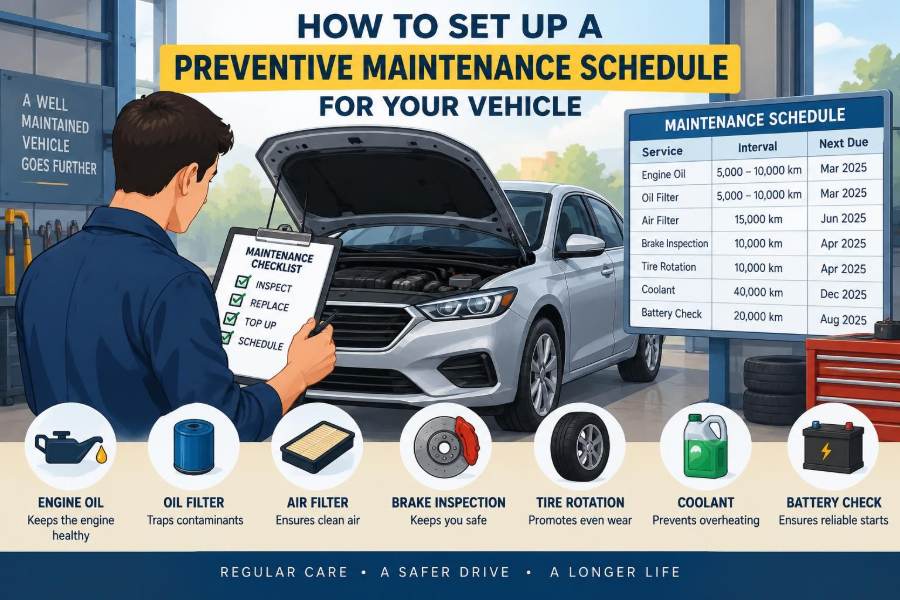

A vehicle rarely fails without giving some warning. The warning may be a dashboard message, a faint brake squeal, a steering vibration, or simply an oil-change reminder that keeps being postponed because the car still seems to run normally.
That is how maintenance becomes expensive: small, predictable jobs are delayed until they damage another component or leave the driver stranded. A neglected coolant leak can become overheating; worn brake pads can damage rotors; low tire pressure can shorten tire life and reduce control.
A preventive maintenance schedule changes the question from “What has broken?” to “What needs attention before it causes a problem?” It is a practical system for tracking inspections, fluids, wear items, and service history.
For students learning vehicle systems and professionals managing daily transport, the goal is not to service parts at random. It is to use the right interval, observe the vehicle’s actual operating conditions, and act early when evidence calls for it.
🧰 Understand What Preventive Maintenance Means
Preventive maintenance is planned inspection and service intended to keep a vehicle operating safely and reliably. It includes routine actions such as checking fluids, replacing filters, rotating tires, and inspecting brakes before a failure occurs.
It differs from corrective maintenance, which begins after a fault is found. Replacing a failed alternator is corrective work; checking the charging system after repeated slow starts may help identify a developing problem before complete failure.
A good schedule does not promise that nothing will ever break. It reduces avoidable wear, provides earlier fault detection, and creates a record that makes diagnosis easier later.
🎯 Define the Purpose of Your Schedule
Start by deciding what the schedule must achieve. For most privately owned cars, the priorities are safety, dependable transportation, fuel efficiency, and preservation of vehicle value. A delivery vehicle or taxi may place much more emphasis on uptime and frequent inspections.
Your purpose determines the level of detail. A basic personal schedule can track dates, mileage, and observations. A fleet-oriented schedule may also record labor, parts, recurring faults, tire positions, and vehicle downtime.
- Prevent safety-related failures.
- Maintain manufacturer warranty requirements where applicable.
- Detect abnormal wear before it spreads.
- Plan service costs instead of reacting to emergencies.
- Create useful information for resale or technical diagnosis.
📘 Begin With the Owner’s Manual
The owner’s manual is the vehicle-specific starting point. It identifies approved fluid specifications, capacities, warning indicators, tire pressures, and manufacturer service intervals. These details vary substantially between engines, transmissions, brake systems, and model years.
Do not substitute a generic internet checklist for the manual. For example, some transmissions have no conventional dipstick, some engines use timing chains rather than timing belts, and some coolant formulations must not be mixed.
Find the maintenance schedule, usually organized by distance, time, or both. If the original manual is missing, obtain the correct version for the exact model, engine, and year from a reliable manufacturer source or dealer.
🗓️ Use Both Time and Mileage Triggers
Wear does not depend only on distance traveled. Engine oil degrades with heat cycles and contamination, brake fluid can absorb moisture over time, and tires age even when a vehicle is parked. For this reason, service schedules commonly state “miles or months, whichever comes first.”
A car driven a short distance once a week may reach mileage intervals slowly, yet still need time-based servicing. Conversely, a high-mileage commuter may reach mileage limits well before a calendar reminder appears.
Record both the current odometer reading and the service date every time work is completed. Your next due date should be based on whichever limit arrives first.
🌦️ Identify Your Operating Conditions
Manufacturer manuals often distinguish between normal and severe service. “Severe” does not necessarily mean dramatic off-road driving. It can describe frequent short trips, long idling, heavy stop-start traffic, towing, dusty roads, extreme heat or cold, or repeated mountain driving.
These conditions increase heat, contamination, load, or cycling. A vehicle that makes many short urban trips may not allow engine oil to reach operating temperature long enough to evaporate moisture effectively.
Choose the schedule that reflects how the vehicle is actually used, not how it is advertised or how it was used by a previous owner.
🔢 Establish a Reliable Starting Point
Creating a schedule is easiest immediately after a known baseline service. If the history is complete and credible, enter the last service dates and mileage into your record. If history is uncertain, arrange an inspection and bring key items up to date.
A baseline service often includes checking fluid condition and levels, tire condition and pressure, brake wear, battery condition, filters, belts, hoses, lights, and diagnostic trouble codes. It does not mean replacing every part automatically.
Ask the technician to distinguish between items that are due by schedule, items showing wear, and items that merely need monitoring. That distinction prevents both neglect and unnecessary work.
📝 Build a Maintenance Record That You Will Use
A paper logbook, spreadsheet, phone reminder system, or maintenance app can work. The best system is the one you will update after every visit, repair, and inspection.
For each entry, record the date, odometer reading, work performed, parts or fluids used, and the next planned interval. Keep invoices, especially for major services, tires, batteries, and warranty repairs.
| Record field | Why it matters |
|---|---|
| Date and odometer | Sets time- and mileage-based next service points. |
| Service performed | Prevents duplicate work and reveals missed items. |
| Fluid or part specification | Confirms compatible materials were used. |
| Observations | Tracks developing noises, leaks, or uneven wear. |
| Next due point | Turns a past record into an actionable plan. |
🚦 Divide Tasks by Inspection Frequency
A schedule becomes manageable when tasks are grouped by how often they need attention. Some conditions can change quickly, while other components require only periodic professional inspection.
Quick checks
Before long trips or at regular fuel stops, observe warning lights, tire appearance, lights, and any new leaks. Check engine oil when the manufacturer’s procedure calls for it, on level ground with the engine in the specified condition.
Periodic checks
Monthly or seasonal checks can cover tire pressure, wiper condition, washer fluid, coolant reservoir level, battery terminals, and visible belts and hoses. Scheduled workshop services address deeper inspections and replacements.
🛢️ Plan Engine Oil and Filter Service Carefully
Engine oil lubricates moving parts, carries heat away from loaded surfaces, helps control deposits, and supports some variable valve timing systems. The filter removes contaminants but has limited capacity.
Use the viscosity grade and performance specification stated by the manufacturer. “Oil is oil” is not a safe assumption: the required formulation may be linked to turbocharger protection, emission-control hardware, fuel economy, or timing-chain wear.
Change oil and filter at the specified interval or earlier when the manual’s severe-service schedule applies. An oil-life monitor can be useful, but it should not override low oil level, a warning lamp, obvious contamination, or a known mechanical fault.
💧 Monitor Coolant and the Cooling System
Coolant transfers heat from the engine to the radiator and protects internal passages from freezing and corrosion. The cooling system also depends on hoses, clamps, a pressure cap, thermostat, water pump, radiator, and electric fans.
Check the reservoir level only when the engine is cool and use the specified coolant type. Mixing incompatible coolant chemistries may reduce corrosion protection or create deposits, so topping up with an unknown product is not a casual decision.
A falling coolant level is not normal consumption in the way fuel is. Look for external leaks, sweet odors, residue around joints, overheating, or unexplained loss, and have the cause diagnosed.
🛑 Make Brake Inspection a Safety Priority
Brake pads, discs or rotors, calipers, hoses, and brake fluid work as a system. Pad thickness alone does not describe the whole system’s health; uneven wear can indicate a sticking caliper, seized slide pin, or hardware problem.
Include brake inspection at each tire rotation or routine service. Listen for grinding, feel for pulling, vibration, a soft pedal, or increased stopping distance. These symptoms deserve prompt assessment rather than waiting for the next planned service.
Brake fluid replacement is often time-based because many common fluids absorb moisture. The correct interval and fluid specification must come from the vehicle documentation.
🛞 Treat Tires as Wear Items and Safety Components
Tires are the vehicle’s only contact with the road. Their pressure, tread depth, age, construction, and condition influence braking, wet-road grip, steering response, ride, and fuel use.
Check pressure when tires are cold, using the pressure listed on the vehicle placard rather than the tire sidewall maximum. Inspect tread for embedded objects, bulges, cracking, and uneven wear.
Rotate tires at the recommended interval if the tire design and vehicle setup allow it. Directional, staggered, and some performance tire arrangements may have specific rotation restrictions.
📐 Use Tire Wear to Spot Alignment Problems
Uneven tire wear is valuable diagnostic evidence. Excessive wear on one edge can be associated with alignment angles, while cupping or scalloping may point toward balance, suspension, or damping concerns. The pattern must be interpreted in context.
Wheel alignment adjusts angles such as toe and camber so the wheels track as intended. It is sensible after a significant pothole strike, collision repair, suspension work, repeated uneven wear, or a steering pull.
Do not assume every steering pull is alignment. Tire conicity, road crown, brake drag, and tire-pressure differences can produce similar behavior.
🔋 Include the Battery and Charging System
A battery starts the engine and stabilizes the electrical system. The alternator recharges the battery while the engine runs, but its output, wiring, belt drive, and control system all affect charging performance.
Inspect terminals for corrosion and ensure hold-down hardware is secure. A loose battery can suffer vibration damage and can create dangerous electrical faults. Many workshops can perform a battery and charging-system test during routine service.
Repeated slow cranking, dimming lights, or an electrical warning lamp should trigger diagnosis. Replacing a battery without testing the charging system may leave the underlying cause unresolved.
🌬️ Replace Filters for the System They Protect
Engine air filters protect intake components from abrasive dust, while cabin air filters improve airflow through the heating, ventilation, and air-conditioning system. Fuel filters, where fitted as serviceable items, protect fuel-system components.
Replace filters according to the manual and real operating conditions. Dusty routes can load an engine air filter sooner than a normal interval suggests. A clogged cabin filter may reduce airflow and contribute to window fogging.
Filter replacement is generally straightforward, but incorrect installation can allow unfiltered air to bypass the sealing surface. Check that the cover and gasket seat correctly.
🧯 Watch Belts, Hoses, and Rubber Components
Rubber and elastomer parts deteriorate from heat, ozone, oil exposure, flexing, and age. Inspect accessible hoses for swelling, cracks, softness, abrasion, and leaks around clamps. Inspect drive belts for cracking, glazing, frayed edges, and abnormal noise.
Some engines use a timing belt that must be replaced at a prescribed interval because its failure can cause engine damage in certain designs. Others use a timing chain, which is not usually a fixed-interval service item but still requires attention if symptoms or diagnostic evidence suggest wear.
Never reach into an engine bay near moving belts, fans, or hot components. Professional inspection is appropriate where access is limited.
⚙️ Do Not Neglect Transmission and Driveline Fluids
Automatic transmissions, manual gearboxes, transfer cases, and differentials may use different lubricants with tightly controlled specifications. These fluids manage lubrication, heat, hydraulic operation, or gear protection depending on the component.
Follow the manufacturer’s stated service method. A transmission service may require a specific temperature, fill procedure, scan tool, or fluid level check; an incorrect process can cause damage or poor shifting.
Leaks, delayed engagement, harsh shifts, shuddering, whining, or burning odor are not routine maintenance reminders. They are symptoms that should be assessed before choosing a fluid service as the solution.
🕯️ Schedule Ignition and Fuel-System Checks
Spark plugs wear gradually, and their replacement interval varies widely by plug material and engine design. Worn plugs can contribute to misfires, poor starting, reduced efficiency, and added stress on ignition coils.
Modern fuel injection systems usually need less routine adjustment than older carbureted systems. Still, poor fuel quality, contaminated fuel, intake leaks, failing sensors, or injector faults can affect drivability.
Use the fuel grade specified for the engine. Higher octane is not automatically better unless the manufacturer requires or permits it for a particular operating benefit.
💡 Check Lights, Wipers, and Visibility Systems
Visibility equipment is easy to overlook because failures are often discovered at night or during bad weather. Include headlamps, brake lamps, turn signals, reverse lamps, hazard lamps, license-plate lamps, mirrors, washer jets, and wiper blades in routine checks.
Replace streaking or torn wipers before heavy rain reveals the problem. Keep washer fluid suitable for local temperatures; plain water can freeze in cold conditions and may not clean road film effectively.
If a headlamp repeatedly fails, do not only replace the bulb. Check for moisture intrusion, heat damage, connector issues, or an electrical fault.
📡 Take Warning Lights and Messages Seriously
Dashboard warnings range from service reminders to urgent fault indicators. Their colors and symbols vary, but a red warning commonly signals a condition requiring immediate attention, while amber often indicates a fault or service need that should be addressed soon.
Read the manual rather than guessing. An engine warning light may relate to emissions control, ignition, fuel delivery, sensors, or other systems; it does not identify one specific failed part by itself.
A diagnostic scan retrieves stored fault codes, but codes guide diagnosis rather than replace it. A code can describe an abnormal signal without proving which component caused that signal.
🔍 Add Seasonal Readiness Checks
Seasonal changes alter what a vehicle needs. Before winter, inspect tires, battery condition, lights, wipers, heater and defroster operation, and coolant protection appropriate for local temperatures. Carry suitable emergency equipment for the expected environment.
Before hot weather or long summer journeys, inspect tire condition, cooling-system performance, air-conditioning operation, and fluid levels. Towing, high passenger loads, steep grades, and high ambient temperature all add thermal load.
Seasonal checks are not a substitute for scheduled service. They focus on conditions likely to be tested by the months ahead.
🛣️ Prepare Differently for Long Trips
A road trip is a useful trigger for a focused pre-departure inspection. Check tire pressures including the spare where fitted, fluid levels, wipers, lights, visible leaks, and the condition of the emergency kit.
If regular service is nearly due, complete it before travel rather than hoping the vehicle will comfortably exceed the interval. Review whether navigation, charging cables, locking wheel-nut keys, and any tire-repair equipment are present and usable.
For trailers, verify the vehicle’s towing limits, hitch condition, trailer lights, tire condition, load distribution, and increased maintenance demands.
👂 Use Your Senses Between Service Visits
Drivers are often the first people to notice a change. A new clicking sound on turns, a squeal at startup, a hot smell after driving, a vibration through the steering wheel, or a wet patch under the vehicle can provide an early clue.
Write down when the symptom occurs: cold start, braking, turning, acceleration, highway speed, wet weather, or with air conditioning on. This context helps a technician reproduce and diagnose the issue.
Do not attempt to diagnose solely by sound descriptions online. Similar symptoms can have very different causes, and safety-related noises should not be deferred.
🧪 Separate Inspection From Automatic Replacement
A preventive schedule should include both scheduled replacements and condition-based decisions. Engine oil may have a defined interval, while brake pads, tires, suspension joints, and wipers need replacement according to measured wear or condition.
This approach avoids two opposite mistakes: replacing safe parts prematurely and running worn parts beyond a safe limit. Ask for measured findings where practical, such as brake-pad thickness, tire tread depth, battery test result, or evidence of leakage.
Condition-based maintenance relies on competent inspection. If evidence is unclear, seek a second opinion rather than authorizing major work based only on a vague recommendation.
💰 Budget for Planned Work and Unplanned Findings
Maintenance is predictable only up to a point. Routine items can be planned, but inspections may reveal a leaking seal, damaged tire, corroded component, or worn suspension part that needs earlier attention.
Set aside funds for scheduled services and maintain a separate allowance for repairs. This reduces the temptation to postpone safety-critical work because it was not expected that month.
Compare service quotes by scope, parts specification, labor, and warranty—not only the final figure. A low quote may exclude fluid, filters, disposal, diagnostic time, or related hardware.
🏪 Choose Who Performs Each Task
Many owners can safely handle simple work such as checking tire pressure, adding approved washer fluid, replacing wiper blades, and documenting observations. More complex work may require lifting equipment, torque specifications, diagnostic tools, or procedures that affect safety systems.
Select a competent workshop familiar with your vehicle type, particularly for hybrid, electric, advanced driver-assistance, diesel-emissions, transmission, and air-conditioning systems. Ask for clear explanations of findings and retain the paperwork.
For do-it-yourself work, use reliable repair information, correct tools, and safe support equipment. Never work beneath a vehicle supported only by a jack.
🔌 Account for Hybrid and Electric Vehicle Needs
Hybrid and electric vehicles still need tires, brakes, suspension checks, cabin filters, wipers, coolant circuits in some designs, and brake-fluid service. Regenerative braking can reduce friction-brake wear, but it does not eliminate the need for brake inspections.
High-voltage systems require special precautions. Orange cables and high-voltage components should not be treated like ordinary 12-volt wiring. Follow the manufacturer’s procedures and use qualified service personnel for high-voltage faults.
Also track charge-port condition, charging-cable damage, and any cooling-system requirements specified for the battery or power electronics.
🚫 Avoid Common Scheduling Mistakes
The most frequent mistake is relying on memory. The second is treating every dashboard reminder as optional while assuming every workshop recommendation is mandatory. Good maintenance needs records and evidence.
- Using the wrong fluid because it is available or cheaper.
- Checking tires only when they look visibly flat.
- Ignoring a small leak because the vehicle still drives.
- Resetting a service reminder without completing the service.
- Replacing parts based on guesswork instead of inspection.
- Forgetting time-based items on low-mileage vehicles.
A schedule is useful only when it is reviewed after changes in driving pattern, climate, vehicle age, or repair history.
📊 Create a Simple Working Schedule
Place recurring tasks in a calendar or log using the manual’s intervals. Keep each entry short and specific: “engine oil and filter,” “inspect brakes and rotate tires,” or “replace brake fluid,” rather than a vague note such as “service car.”
A practical setup can use three reminder windows: upcoming, due now, and overdue. Set the reminder slightly before the actual limit so appointments and parts can be arranged without rushing.
- Record today’s mileage and date.
- Enter all known last-service information.
- List manufacturer intervals for your exact vehicle.
- Mark severe-service adjustments that apply to your use.
- Set calendar and mileage reminders.
- Update the record immediately after every completed task.
✅ Review and Improve the Plan Each Year
Once a year, review the service record as a whole. Look for repeated battery issues, unusual tire wear, frequent fluid top-ups, recurring warning lights, or repairs that suggest a pattern. A schedule should evolve when evidence changes.
Reviewing also helps reconcile work completed by different garages. Confirm that items recorded as inspected were actually checked and that recurring services have not been missed because the vehicle changed hands or shops.
This annual review is especially useful before a warranty expires, before a long journey, or when deciding whether to keep, sell, or purchase an extended service plan.
🏁 Build a Schedule Around Evidence and Consistency
The central principle is simple: follow the vehicle-specific maintenance requirements, adapt them to real operating conditions, and respond quickly to changes that inspection or driving behavior reveals. A schedule is not a rigid list detached from the vehicle; it is a living record of its needs.
Regular checks catch visible problems, manufacturer intervals protect systems with known service needs, and professional diagnosis addresses symptoms that cannot be safely identified from the driver’s seat. Together, these actions reduce uncertainty without encouraging unnecessary replacement.
Consistency matters more than complexity. A modest record that is updated after every service is more valuable than a detailed spreadsheet abandoned after one month.
A preventive maintenance schedule works when it turns small observations and known service intervals into timely action before they become larger repairs or safety concerns. Keep the plan simple, keep the records accurate, and let the vehicle’s condition guide the next decision. 🚗🧰✅